Clough Medal Lecture 2024-25

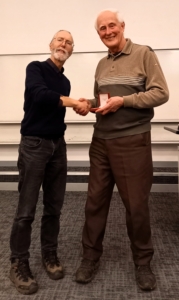
Mike (right) being presented with his Clough Medal 2024 by Mark, our President

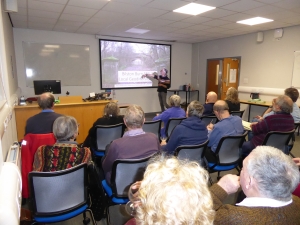
On 26 February 2025 our annual Clough Medal lecture took place at the Grant Institute, Kings Buildings Campus, University of Edinburgh and also held online. The audience for this year’s lecture was again sizable, both physically present and on-line.  Proceedings for the evening were chaired by Alastair Milne, Lectures Secretary.

Our president, Mark Wilkinson, explained that the Clough Medal was established in 1935 and is given each year to a person whose original work has materially increased the knowledge of the geology of Scotland and/or the north of England, or one working in Scotland or the north of England who has significantly advanced the knowledge of any aspect of geology.

The medallist for 2024/25 was Mike AE Browne (formerly BGS Edinburgh) who gave a lecture entitled “Geoconservation in Scotland”.  Beforehand, he was presented with his medal by Mark Wilkinson.

Mike used his lecture to cover the full breadth of activities around Geoconservation in Scotland, that he (& others – David McAdam, Elspeth Urquhart, Clifton Porteous, Victor Patridge, John Sheldon and Archie Miller to name but a few) had been involved over the last few decades.  His introductory slide provided a summary of his talk: i) Useful Carboniferous Stratigraphy; ii) Beginnings of Scottish Geoconservation; iii) International Conservation Accolades; iv) National Designations: SSSIs; v) Regional Accolades; vi) Local Geodiversity Sites (LGS) System and vii) Possible New Conservation Sites. In virtually all aspects, Mike has made a valuable contribution and been a leading light in many for over 50 years.

Mike estimated that he had spent roughly even split of his time on the Devonian and Carboniferous strata. This is reflected in his co-authorship of the relevant chapters of both the 4th and 5th editions of “The Geology of Scotland”. He has worked on both national and local government projects, particularly in connection with geothermal energy where his work over many years continues to form an important reference source.  He has been committed to education, having supervised a number of PhD students, and to the promotion of geology to the wider community.  He has also been the Chair of GeoConservation UK for a number of years and continues to Chair Lothian and Borders GeoConservation.

Mike has also made a valuable contribution to the EGS, having been first elected to Council in 1986, he has served as a Vice-President on three separate occasions, was our acting President in 2022-23 and Assistant Secretary (Geoconservation) from 2017 to present.

The vote of thanks was given by Alastair Milne who said that geoconservation requires work and which Mike had demonstrated in spade loads. He said that we all need to be inspired by Mike’s work.  Finally, Mike made a plea to everyone to take more photos of geoconservation sites and to share them with the relevant bodies, for instance through the Scottish Geology Trust’s Geosites project.

If Members weren’t able to attend physically or virtually, a recording of Mike’s lecture is now available on our YouTube channel.
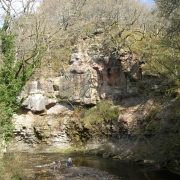
Local Geodiversity Sites in Midlothian

Fellows’ Night 2022 – No. 189!

On 14th December 2022, the Edinburgh Geological Society held its 189th Fellows’ Night at the Grant Institute, University of Edinburgh. This meeting takes place each year, close to the anniversary of the foundation of the Society (on 6th December). 
The pandemic has meant that a “normal” Fellows’ Night has not taken place for a few years now.

This year we were determined to be “normal” again and so an in-person event was held at which a series of short talks were given by members and some refreshments enjoyed by all.
Four speakers were lined up for this event, but first Mike Browne (acting EGS President) gave a thank you to both Alison and Barry Tymon for their contribution to geoconservation in the Midlothian and Scottish Borders recently, and in Yorkshire previously. This work has added significantly to the total of number of local sites recognised for their geological interest across the Lothian and Borders region to 166.

The talks kicked off with Angus Millar (EGS Promotion Coordinator) (and his dog) taking up a challenge to visit 30 geoconservation sites in the month of November, and yes, he achieved this – 32 in fact and despite wet weather. Sites visited varied from Kilspindie beach erratics to the Eildon Hills, and Carlops glacial drainage channels to River Clyde oxbow lochs and active meanders. A fascinating demonstration of the breadth of geological sites on our doorsteps.

Second up was Bob Gatliff who updated Fellows on Siccar Point activities in 2022 – the embarking on the process of getting UNESCO heritage status for Hutton’s Unconformity, obtaining widespread support for the project and recognition by IUGS of Siccar Point being one of the first one hundred sites recognised for its geological heritage significance.

Thirdly, Mark Williamson (University of Edinburgh) described his geological reconnaissance of the Bilston Glen SSSI as a location for future undergraduate student visits. Its combination of mining heritage and exposures of the Lower Carboniferous (not always so clear) was described.

Finally, we heard from Prof James Floyd on his “Ships of stones” which described some fascinating collections of ornamental decoration using geologies from around the world. He explained how he discovered these treasures when engaged to give lectures on cruise ships. This had led to the discovery that not only was the best geology to be found at the islands they visited but that on board many of the ships was a wealth of geological interest as well (sadly not being recognised by many of the crew members and passengers).

In conclusion, I think everyone who attended came away with the feeling that geology surrounds us everywhere and that although not everywhere has that notice board just yet, there are a huge number of resources available through the EGS website (the Autumn Members’ Challenge is a good place to start).

We look forward to many more Fellows’ Nights in the future.

Merry Christmas and a Happy New Year,

Neil Mackenzie, EGS Secretary.

Local Geodiversity Sites in Scottish Borders

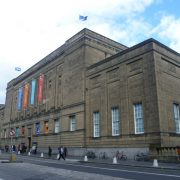
By Kim Traynor - Own work, CC BY-SA 3.0, https://commons.wikimedia.org/w/index.php?curid=21286316

Vote Geology

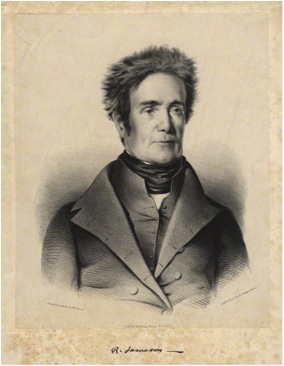
Prof Robert Jameson (1774-1854)

The National Library of Scotland (NLS) has a new display in the front hall of the George IV Bridge building in Edinburgh. The display features three diverse collections in need of conservation treatment, including a selection of 20th century booklets, a group of geological charts and a volume of 20 historical pamphlets. All of the items will be conserved but the winner of a vote which runs until the 8th September, will have its treatment documented under the social media hashtag #Rescueme.

The geological charts are those produced by Robert Jameson (1774-1854), Professor of Natural Sciences at the University of Edinburgh and where he taught both Darwin and Forbes.  He also produced a book on the mineralogy of the Western Isles. It would clearly be good to see his drawings better preserved and also to be able to follow this on social media.

To give the geological charts the best chance of winning, we need your votes either by visiting the George IV Bridge building or alternatively by using the buttons on the Twitter feed @natlibscot

Please note that NLS is open until 7pm Mon-Thur and until 5pm Fri-Sat.  Closed Sun.  The vote closes on the 8th September.

Raised dinosaur print

Dinosaur footprints discovered on mainland Scotland for first time

Raised dinosaur print

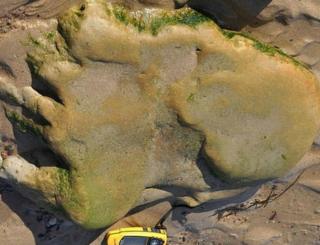
Raised dinosaur print by Dr. Neil Clark

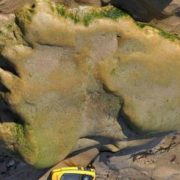
Evidence of fossilised dinosaur footprints has been found on the Scottish mainland for the first time, on the coast near Inverness. The exact location is being kept secret to enable researchers to have access to the site. The discovery, by Dr. Neil Clark, Vice-President of the Geological Society of Glasgow and Curator of Palaeontology at the Hunterian in Glasgow, has been hailed as a significant find. The main site for dinosaur footprints and bones in Scotland is on the Isle of Skye and this significant new find is likely to give further insight into the dinosaurs of the Middle Jurassic period, some 170 million years ago. It is thought that the size of the newly discovered prints suggests they were left by a member of the sauropod family – large herbivores which stood up to 18 metres high.


This news item is to linked to a previous story posted on the EGS website – Preserving dinosaur footprint sites in Scotland.

Preserving dinosaur footprint sites in Scotland

Sauropod footprint on Skye. Image courtesy Steve Brusatte.

The Edinburgh Geological Society has been contacted by Dr Neil Clark (Curator of Palaeontology, The Hunterian, University of Glasgow) regarding a campaign to raise £5,000 to undertake mapping of some new dinosaur footprint sites in Scotland. The new locations will it is claimed add significantly to the understanding of Middle Jurassic dinosaurs. The funding is to go towards the purchase of suitable drone to help with the mapping and photographic record of the footprints as well as 3D software to undertake referenced measurements of the rate of erosion from stormy seas in future years. The funding will also support student engagement in the project with transport and accommodation costs. A number of researchers from both Scottish Universities and Institutions are involved in this exciting geoconservation project.

The project has created a crowdfunding site for those interested in offering financial support to the project.
https://www.justgiving.com/crowdfunding/scottish-dinosaurs

For further details, please contact Neil.Clark@glasgow.ac.uk

Local Geodiversity Sites in Edinburgh