Meeting young Mr Hutton

The Edinburgh Geological Society’s Introducing James Hutton event took place at Dynamic Earth on 6 October 2025.  The event also launched the Tercentenary celebrations for 2026, marking 300 years since Hutton’s birth on 3 June 1726.  A large crowd of over 150 people attended this event, and we heard from three guest speakers; Prof Colin Campbell (CEO, James Hutton Institute), Dr Rachel Walcott (Head of Mineral, Meteorite and Rock collections at the National Museums Scotland) and Dr Angus Miller (Promotions Coordinator, EGS).  Our compere for the evening was Dr Hermione Cockburn (Trustee, National Museums Scotland).

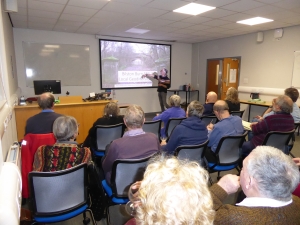
A highlight of the evening was a visit from young Mr Hutton, aged nineteen in 1745 – ably played by Edinburgh actor Danny Gorringe.  We learnt much about his time in Edinburgh, his family circumstances, his ambitions and plans that might lay ahead for him.

The Tercentenary celebrations, including the new Deep Time Trail at Siccar Point, will be supported by our Crowdfunder appeal, which runs until the end of November.  All contributions to the appeal aimed to raise £75,000 will be duly welcomed. There are plans a foot for lectures, exhibitions and excursions during 2026.  Events will be held across Scotland, including in the village of Cockburnspath in the Scottish Borders.

Finally, the EGS President, Prof Mark Wilkinson took the microphone at the end of the evening to announce the awarding of two Honorary EGS Fellowships; the first to one of speakers on the evening, Prof Colin Campbell in recognition of his leadership in promoting James Hutton and the Tercentenary  and secondly, to musician Karine Polwart, in recognition of her encouragement of public interest in geology through music and writing.

Thank you to all the contributors and organisers behind the scenes who made this such a successful launch of the Tercentenary year.

Clough Medal Lecture 2024-25

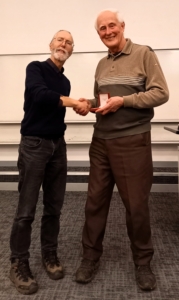
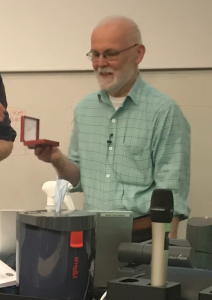
Mike (right) being presented with his Clough Medal 2024 by Mark, our President

On 26 February 2025 our annual Clough Medal lecture took place at the Grant Institute, Kings Buildings Campus, University of Edinburgh and also held online. The audience for this year’s lecture was again sizable, both physically present and on-line.  Proceedings for the evening were chaired by Alastair Milne, Lectures Secretary.

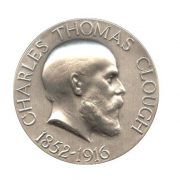
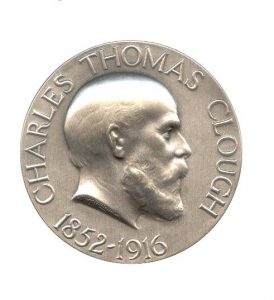
Our president, Mark Wilkinson, explained that the Clough Medal was established in 1935 and is given each year to a person whose original work has materially increased the knowledge of the geology of Scotland and/or the north of England, or one working in Scotland or the north of England who has significantly advanced the knowledge of any aspect of geology.

The medallist for 2024/25 was Mike AE Browne (formerly BGS Edinburgh) who gave a lecture entitled “Geoconservation in Scotland”.  Beforehand, he was presented with his medal by Mark Wilkinson.

Mike used his lecture to cover the full breadth of activities around Geoconservation in Scotland, that he (& others – David McAdam, Elspeth Urquhart, Clifton Porteous, Victor Patridge, John Sheldon and Archie Miller to name but a few) had been involved over the last few decades.  His introductory slide provided a summary of his talk: i) Useful Carboniferous Stratigraphy; ii) Beginnings of Scottish Geoconservation; iii) International Conservation Accolades; iv) National Designations: SSSIs; v) Regional Accolades; vi) Local Geodiversity Sites (LGS) System and vii) Possible New Conservation Sites. In virtually all aspects, Mike has made a valuable contribution and been a leading light in many for over 50 years.

Mike estimated that he had spent roughly even split of his time on the Devonian and Carboniferous strata. This is reflected in his co-authorship of the relevant chapters of both the 4th and 5th editions of “The Geology of Scotland”. He has worked on both national and local government projects, particularly in connection with geothermal energy where his work over many years continues to form an important reference source.  He has been committed to education, having supervised a number of PhD students, and to the promotion of geology to the wider community.  He has also been the Chair of GeoConservation UK for a number of years and continues to Chair Lothian and Borders GeoConservation.

Mike has also made a valuable contribution to the EGS, having been first elected to Council in 1986, he has served as a Vice-President on three separate occasions, was our acting President in 2022-23 and Assistant Secretary (Geoconservation) from 2017 to present.

The vote of thanks was given by Alastair Milne who said that geoconservation requires work and which Mike had demonstrated in spade loads. He said that we all need to be inspired by Mike’s work.  Finally, Mike made a plea to everyone to take more photos of geoconservation sites and to share them with the relevant bodies, for instance through the Scottish Geology Trust’s Geosites project.

If Members weren’t able to attend physically or virtually, a recording of Mike’s lecture is now available on our YouTube channel.

Fellows’ Night 2024 – No. 191!

Fellows’ Night 2024

On 11th December 2024, the Edinburgh Geological Society held its 191st Fellows’ Night at the Grant Institute, University of Edinburgh. This meeting takes place each year, close to the anniversary of the foundation of the Society (on 6th December).

The Cockburn Museum, and close by lecture rooms provided the backdrop for a fun and lively event comprising a series of short talks which were given by members, and with time in between to enjoy some nibbles and refreshments.

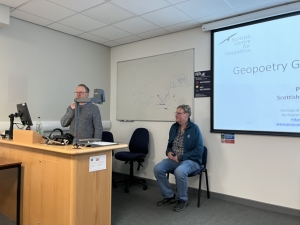
Our host for this in-person event was Angus Miller (our Promotion Coordinator).  Three speakers were lined up for this event with varied topics from Geopoetry, the history of Oil Exploration in Scotland and the Brora Sandstone/Scottish land mass evolution.

Our first speaker was Patrick Corbett (Emeritus Prof of Petroleum Geology at Heriot Watt University).  He explained what the term Geopoetry was and its origins, and updated us on the sad passing away of its founder Kenneth White from Fairlie in 2023.  He explained how a conference had been held in Burlington House (HQ of the Geological Society of London) – a first for the esteemed organisation.  A proceeding of this event is due to be published in the new year.  Patrick also read a poem about Isle of Luing, written on piece of slate from the island in the Firth of Lorn.

Second up was Simeon Brown (a former oil industry geologist who has work in both Africa and in various European countries), and who had kindly offered to talk through the development of the oil industry in Scotland since 1850.  From the first observed seeps at St Katherine’s “Balm” Well, in Liberton through to the extensive extraction of oil shales near Livingstone (and their legacy waste piles of the Bings).  He then covered the onshore “nodding donkeys” wells and more recently the Coal Bed Methane pilot site near Airth between 2008-15. A fascinating picture was outlined and set against a consideration of climate change through the same period – alongside recent volcanic eruptions which may also have played a part (and which has been captured by Turner’s paintings and Icelandic proverb which he shared).

Thirdly, Mark Williamson (EGS President and Professor of GeoEnergy at the University of Edinburgh) described his regular geological visits with undergraduate students to the Jurassic age Brora Sandstone Formation outcrops around Helmsdale, Northeast Scotland. These sequences are model for the North Sea and with the dynamic coastal processes regularly providing new things to see.  One such find was of a series of pebbles in the sandstone and their origin has lead Mark on an investigation of possible sources for this fluvial derived material.  He hypothesised that its origin may be from the outcrops on the South side of Moray Firth, meaning that in order for this to be emplaced, then the land mass to the south must have been shedding material all across the area which is now the Moray Firth marine environment.  Hence, the shoreline of Nor Scotland may not have been quite so static as others, including Prof John Judd FGS might have thought.

In conclusion, Angus said that as with all good Fellows’ Nights we had ranged extensively across the various topics but that all had strange inter-linkages reflecting how geology informs all aspects of our lives.  We finished off the evening with a vote of thanks to the speakers and also, to Bob Gatliff (former EGS President) who had so kindly done the food and drink shopping for another year.

We look forward to many more Fellows’ Nights like this in the future.

Merry Christmas and a Happy New Year.

Grant Inst Lecture Theatre

Clough Medal Lecture 2023/24

Tony Prave presentation

Tony being presented with Clough Medal 2023-24

Our annual Clough Medal lecture took place on 28th February at the Grant Institute, Kings Buildings Campus, University of Edinburgh and also broadcast online. The audience for this years’ lecture was well over 100 (50+ in person and 54 on line).  Whether the fact that the lecture was preceded by a “pizza and pop” event, kindly supported by a donation from an EGS Fellow, or whether it was cohort of Tony Prave’s supporters from the University of St Andrews, it did make for a great atmosphere on the evening.

Graham Leslie, Chair of the Clough Committee had the honours of explaining that the Clough Medal was established in 1935 and is given each year to a person who has contributed to a geologist whose original work has materially increased the knowledge of the geology of Scotland and/or the north of England, or one working in Scotland or the north of England who has significantly advanced the knowledge of any aspect of geology.

The medallist for 2023/24 was Professor Antony (Tony) Prave (School of Earth and Environmental Sciences, University of St Andrews) who gave a lecture entitled “There is nothing left to learn about this scrap of NW Europe”.  He was presented with his medal by Mark Wilkinson, President of Edinburgh Geological Society.

Tony Prave started his academic career at The City University of New York in USA, before coming to the University of St Andrews in 1996 as a Senior Lecturer.  For the subsequent 27 years, he has carried a wide range of research; with two programmes having had particular scientific impact: that concerned with the Neoproterozoic, and that with the Palaeoproterozoic. In each case the modus operandi has been the same: (1) meticulous and painstaking fieldwork conducted from a base of deep theoretical knowledge and an open mind; (2) careful screening of samples through petrography and geochemistry; (3) advanced isotope geochemical analyses; and (4) imaginative interpretation of the data within the geological and field context. The impact of his published oeuvre has been substantial and paradigm changing.

Tony has brought new ideas, fresh thinking and novel approaches to study of the Dalradian sequences in both Scotland and Ireland. The complex geological – and especially metamorphic – history and the paucity of robust geochronology resulted in a wealth of opinion and speculation, sometimes dressed up as coherent theory. One grizzled veteran is known to have grouched about Prave’s “Olympian disregard of 40 years of research on the Dalradian”, but as his lecture demonstrated, it was merely that he pointed out that the evidence-base for previous thinking was weak.  Instead, Tony conceived fresh ideas from carefully selected samples of carbonate that might be suitable for carbon isotope chemostratigraphy – pace the adherents of metamorphic overprint – and in this he was spectacularly vindicated (Prave et al. 2009 J.Geol.Soc.Lond.). He has also had significant projects in Namibia and Death Valley, and was a central player with Simone Kasemann and others in applying novel isotopic approaches (including boron, calcium and magnesium isotope ratios) to some classic “Snowball Earth” sections in Namibia.

For the Palaeoproterozoic and the consequences of the Great Oxidation Event (oxygenation of the Earth’s surface) around 2.4Ga, Tony thorough work originated at the Loch Maree Group, became a key player in the multinational Fennoscandia Arctic Russia – Drilling Early Earth Project (FAR-DEEP). He was closely involved in successful funding initiatives to ICDP and NERC and was co-editor on three substantial volumes (each exceeding 500 pages) published by Springer in 2012/13. He followed this success with a similar-scale international drilling project on equivalent age sequences in Gabon.

The vote of thanks was given by Prof Tony Fallick FRSE, FRSA, FMinSoc (Clough Medal, 2013/14). He paid tribute to Tony’s perseverance in proving the doubters wrong on so many occasions and to ensuring that it’s the rocks that cannot lie.  It had been Tony’s ideas and drive that had brought success to the excellent teams both at University of St Andrews and also further afield, and in so doing he is a truly worthy recipient of the Clough Medal.  He asked for thank you from the audience present and online for the speaker and this was duly done by all.

If Fellows weren’t able to attend physically or virtually, a recording of the lecture is available here.

Fellows’ Night 2022 – No. 189!

On 14th December 2022, the Edinburgh Geological Society held its 189th Fellows’ Night at the Grant Institute, University of Edinburgh. This meeting takes place each year, close to the anniversary of the foundation of the Society (on 6th December). 
The pandemic has meant that a “normal” Fellows’ Night has not taken place for a few years now.

This year we were determined to be “normal” again and so an in-person event was held at which a series of short talks were given by members and some refreshments enjoyed by all.
Four speakers were lined up for this event, but first Mike Browne (acting EGS President) gave a thank you to both Alison and Barry Tymon for their contribution to geoconservation in the Midlothian and Scottish Borders recently, and in Yorkshire previously. This work has added significantly to the total of number of local sites recognised for their geological interest across the Lothian and Borders region to 166.

The talks kicked off with Angus Millar (EGS Promotion Coordinator) (and his dog) taking up a challenge to visit 30 geoconservation sites in the month of November, and yes, he achieved this – 32 in fact and despite wet weather. Sites visited varied from Kilspindie beach erratics to the Eildon Hills, and Carlops glacial drainage channels to River Clyde oxbow lochs and active meanders. A fascinating demonstration of the breadth of geological sites on our doorsteps.

Second up was Bob Gatliff who updated Fellows on Siccar Point activities in 2022 – the embarking on the process of getting UNESCO heritage status for Hutton’s Unconformity, obtaining widespread support for the project and recognition by IUGS of Siccar Point being one of the first one hundred sites recognised for its geological heritage significance.

Thirdly, Mark Williamson (University of Edinburgh) described his geological reconnaissance of the Bilston Glen SSSI as a location for future undergraduate student visits. Its combination of mining heritage and exposures of the Lower Carboniferous (not always so clear) was described.

Finally, we heard from Prof James Floyd on his “Ships of stones” which described some fascinating collections of ornamental decoration using geologies from around the world. He explained how he discovered these treasures when engaged to give lectures on cruise ships. This had led to the discovery that not only was the best geology to be found at the islands they visited but that on board many of the ships was a wealth of geological interest as well (sadly not being recognised by many of the crew members and passengers).

In conclusion, I think everyone who attended came away with the feeling that geology surrounds us everywhere and that although not everywhere has that notice board just yet, there are a huge number of resources available through the EGS website (the Autumn Members’ Challenge is a good place to start).

We look forward to many more Fellows’ Nights in the future.

Merry Christmas and a Happy New Year,

Neil Mackenzie, EGS Secretary.

Clough Medal

Clough Medal Lecture 2021/22

On 2 March 2022 at 7pm, the annual Clough Medal lecture took place for the first time as combined physical and virtual event. The medallist for 2021/22 was Dr Tim Smithson who gave a lecture entitled the “A new beginning: recent discoveries in the early Carboniferous of northern Britain reveal rapid faunal replacement following the end-Devonian extinction”. He was presented with his medal by Dr Tom Challands, the President of the Edinburgh Geological Society.

Tim being presented with Clough Medal 2021

A brief outline of Tim’s career was described by Tom: Following his undergraduate studies at the University of Newcastle Upon Tyne (UNUT), 1972- 1975) Tim started his PhD under Alec Panchen at UNUT in 1976 but, being somewhat regarded as a genius in his field, he was offered a post-doctorate position in Montreal to work with Robert Carroll at McGill University before completing his PhD. By the time he had completed his PhD in 1983 Tim had already published four academic papers. Again, before completing his PhD, he was awarded a Sir Jamed Knott Fellowship at UNUT until 1984. Tim’s academic record is all the more impressive given that the major part of his career was spent in teaching and managerial roles in further education and not as a university academic.

During his time in further education (1985-2012), Tim was still actively engaged in fieldwork and research and published 18 research papers including perhaps his most notable work is his discovery and description in 1989 of Westlothiana lizziae (aka ‘Lizzie’) at first considered to be the earliest reptile but now considered to lie on the amniote stem. Besides ‘Lizzie’ Tim has described no less than ten new tetrapods and fourteen new fish taxa from Scotland.

Between 2012-17, he became involved in the highly successful TW:eed (Tetrapod World: early evolution and diversification) project, which was led by the late Prof. Jenny Clack at Cambridge University. He currently holds a position with Department of Zoology, University of Cambridge and continues to publish on all manner of things fossilferous.

Tim’s provided a well-crafted talk telling us about the history of the people involved and also the nature of discoveries. From Prof Alfred Romer (1894-1973), through Prof Stanley Westoll FRS (1912-1995), a previous holder of the Clough Medal in 1976-77, and on until the late Stan Wood (1939-2012); Tim explained how each had played their part in filling the fossil record of the late Devonian/ early Carboniferous period between 359 and 330 Ma.

In his summary, Tim explained that:
• Vertebrates recovered quickly following the end-Devonian extinction;
• There is no evidence for either a fall in atmospheric oxygen or a post-extinction trough;
• Vertebrate diversity is much greater in the Early Carboniferous than previously recognised;
• For tetrapods this diversification probably began in the late Devonian; and
• Romer’s Gap is not a natural phenomenon but is an artefact of previous unsuccessful collecting.

The vote of thanks was given by Dr Dave Millward (ex-BGS) and who thanked Tim for an excellent talk which everyone had enjoyed. He was also thanked for a couple of things; i) being a Zoologist who was also interested in the rocks and ii) for Tim’s (and also the late Prof Jenny Clack’s) word-smithery around the naming of their fossils finds.

If Fellows weren’t able to attend physically or virtually, a recording can be found on our website.

Clough Medal Lecture 2020-21 – Dr Tony Spencer

Tony Spencer on The Garvellachs

On 17th February 2021 our annual Clough Medal lecture took place for the first time as totally virtual event. The medallist for 2020-21 was Dr Anthony M Spencer who gave a lecture entitled the “The Port Askaig Formation in Argyll: uncovering the evidence for repeated climatic change in a Crogenian glacial sequence”. He was presented with his medal (again virtually) by our Vice-President, Prof Emrys Phillips on behalf of the Edinburgh Geological Society.

A brief outline of Tony’s career was described by David Stephenson. Tony had first come across the Garvellach Islands during his Doctoral research at Liverpool University in 1963. He had been presented with the topic his supervisor, Prof Wally Pitcher, who with Prof Robert Shackelton had visited the islands in 1961. Tony completed his PhD in three years and then moved onto a Post-Doctoral research position. Their findings were noticed by the Geological Society of London and led to approval for a Special Publication “Late Pre-Cambrian Glaciation in Scotland” which was published in 1971.

Tony’s career turned in a different direction after this, to more off-shore geology with stints with both BP and Statoil, and in various parts of the globe. He retired in 2012, after which he turned his attentions back to the Garvellach Islands. He then explained how through collaboration with experts in a range of specialisms, they had been able to uncover together so much more, to build on what hade been done before.

The Garvellach Islands lie in the Forth of Lorne, off the west coast of Argyll. There are four main islands and many skerries around them. The islands expose around 550m of the Port Askaig Tillite Formation, around half of its total thickness. Contained with these exposed rocks are 47 diamictites (poorly sorted or non-sorted terrigenous non-calcareous sedimentary rocks). The sequence shows many examples of where grounded ice has scraped at the sediments when these were exposed on land, some marine drop-stones indicate the presence of intruding seas at other times and also periglacial features such a frost polygons and frost shattering of exposed surfaces. In total, they have identified 28 glacial periods, 25 inter-glacial periods and 23 periglacial periods, a total of 76 significant climatic episodes in this one sequence.

Clough Medal

The Clough Medal

We learnt from Tony about how many days had been spent by numerous geoscientists on the islands over the past eight years to gather this data. He also mentioned all the boat trips made to and from the islands by virtue of three generations of the MacLachlan family of Luing.
Finally, Tony touched on the Garvellach’s history of human occupation from AD 542 (1st Century) by monks from Ireland (?) through to just before the 2nd World War when the last residents on island left. Now only migratory geoscientists visit there, many of whom are longing to return for the delayed field season of 2020 (their 9th year!).

The audience for Tony’s talk was spread widely around the globe from the USA to Australia, via Stavanger in Norway where he was presented his lecture for this evening. The vote of thanks was given by Prof Tony Prave (University of St Andrews) who thanked him for a truly unique Clough Medal lecture delivered by virtual means. He also thanked Tony for the time he takes to support a wide range of students and his openness in sharing of ideas, and for explaining his material in such a compelling way.

Anyone who wasn’t able to attend, or would just like to listen again to Tony’s lecture, can find the recording on our YouTube channel, which can be accessed from the Lectures page.

‘Boring’ geology in Glasgow & EGS’ winter lecture programme

Not quite what it may seem, but BGS’ geologists would appear to be doing some interesting new work beneath Glasgow. We have heard directly about plans for this work as part of our previous lecture programme. This BBC news website article from its science section contains some beautiful images from the cores taken from beneath Glasgow. A link to this article is given here.

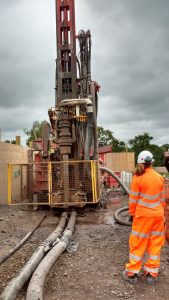
BGS’ geologists drilling at UK Geo-energy Observatory in Glasgow

A reminder that this year’s winter lecture programme 2020/21, will contain a talk by the BGS’ Alison Monaghan on ‘Drilling into mines for heat: the UK Geo-energy Observatory in Glasgow’ on 3 February 2021. This will be joint meeting with the Mining Institute of Scotland.

Before then and to kicking-off our winter lecture programme on Wednesday 14th October will be a lecture on ‘The Falklands Plateau: its role in the break-up of Gondwana – and other geological controversies’ to be presented by Dave McCarthy (BGS) . This meeting will be held virtually and more details can be found at our lectures page.

Hopefully these lectures and others over the winter will indicate that the geology beneath Glasgow (and Edinburgh) is far from ‘boring’.

The Nigel Trewin Memorial Lecture 2020

Clough Medal Lecture – 19 February 2020

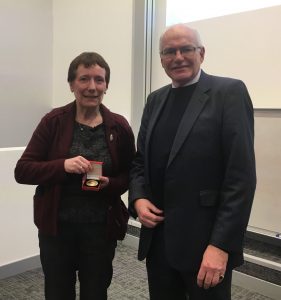
Prof K Whaler & Bob Gatliff – Clough Medal Award 2019

On Wednesday 19th February 2020, EGS Fellows gathered for the Clough Medal lecture held at the University of Edinburgh, Grant Institute.  The 2019-20 Clough Medal was awarded to Professor Kathy Whaler OBE, FRSE, FAGU (University of Edinburgh) for a distinguished career as an academic in the field of geophysics. Our current President, Bob Gatliff presented Kathy with the Clough Medal and was able to remind fellows that this year was notable on two counts. First that Kathy was only the third geophysicist to be awarded the medal and that it was over 40 years since Janet Watson received the medal. Kathy thanked the society for the recognition she had been given and was then able to explain some of the many facets of her research  in a lecture entitled “Adventures with Maxwell’s equations”.

Amongst the topics covered was her research in the field of geo-magnetism, involving the use of geophysics to large-scale earth processes, from the Earth’s core through the crust and even to interpreting the history of Mars geomagnetic record.  She also explained some recent research being undertaken in the Afar region of Ethiopia, called the RiftVolc project, which has drawn together a multidisciplinary group of researchers to understand crustal processes in the East African Rift. Finally, Prof Whaler touched on the future research topics including the important role played by the Earth’s magnetic field in protecting us from solar flares. She is also planning more research within the rift valley, where active volcanoes and the public are found close together.  At the end of the evening, Bob thanked Kathy for the wide ranging and fascinating lecture to celebrate the award of the 2019-20 Clough Medal.