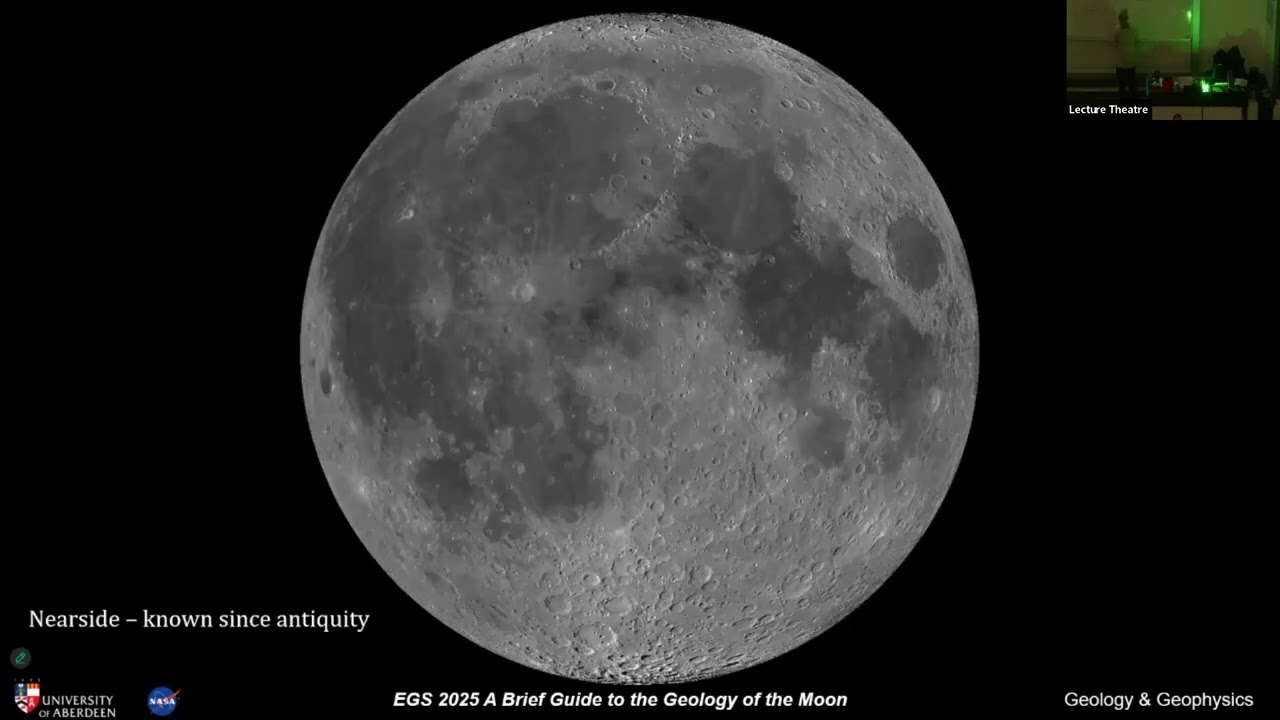
EGS Lecture Programme
Our varied programme of illustrated lectures runs from October to Easter, on Wednesday evenings. These meetings are open to the public, there is no charge, and visitors are most welcome.
Speakers and topics are carefully chosen to provide interest for both the amateur and professional geologist. These meetings also provide an informal opportunity to chat to other members, and find out more about geological sites from local experts. At the annual Fellows’ Night, members give accounts of their own geological interests, specimens or travels.
We will continue to broadcast our lectures online via Zoom and also, if speakers agree, record them for later viewing on our YouTube channel. If you are not a member, please contact Angus Miller (promotion@edinburghgeolsoc.org) for details.
Information about the lectures, including more detailed abstracts where provided, are available below.
This is my first term as Lectures Secretary, and I’m keen to receive your feedback and ideas for the future!
Alastair Milne, Lectures Secretary – email lectures@edinburghgeolsoc.org.
The lectures usually take place in the Hutton Lecture Theatre in the Grant Institute of Geology, The King’s Buildings, James Hutton Road, Edinburgh EH9 3FE.
The Grant Institute is part of the School of Geosciences (it is labelled The Grant Institute on the door). It is one of the large buildings just back from, and facing West Mains Road.
Coming by bus: Lothian service 9 travels along West Mains Road and enters Gate 1 to Kings Buildings to its final stop on David Brewster Road. Head east on David Brewster Road (in the direction the bus is facing), cross over the junction with a large red brick building on the right (School of Chemistry) and a statue of David Brewster on the left. Continue straight ahead at the next junction onto James Hutton Road. Beside this is a large blue information board which includes directions to the Grant Institute. Continue a few metres along James Hutton Road to the first large building on your right, labelled School of Geosciences, Grant Institute.
Coming by car or bike: From West Mains Road turn into Gate 2 of King’s Buildings (the entrance closest to Mayfield Road) onto James Dewar Road. At the first junction, turn left onto James Hutton Road. There is a large blue sign which includes directions to the Grant Institute. Continue a few metres along James Hutton Road to the first large building on your right, labelled School of Geosciences, Grant Institute. Parking is available in front of the building.
Once inside the Grant Institute, turn left and follow the corridor round to the end where you will find the James Hutton Lecture Theatre at the bottom of a short flights of steps (a stair lift is available).
What3Words link for the front door: what3words.com/spends.claims.slate
EGS Evening Lecture Programme 2026-27
Wednesday 14 October, 7pm Ian Molnar, University of Edinburgh
Wednesday 14 October, 7pm
Ian Molnar, University of Edinburgh
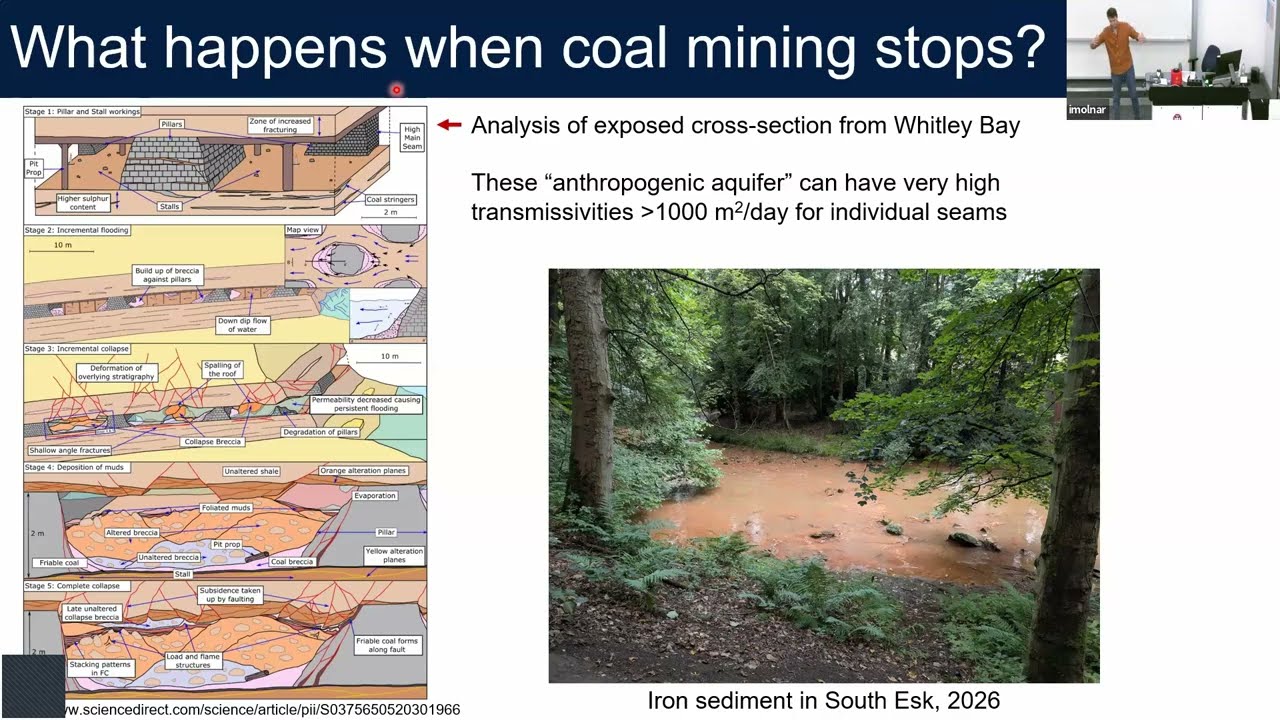
Re-imagining legacy mineworkings as a Geobattery: How Scotland’s flooded coal mines can provide low-carbon cooling for datacentres and heat homes
Minewater, and the subsurface in general, offers an incredible thermal resource for ground-source heat pumps, however the rate of abstraction requires careful management to not outpace the rate of natural heat recharge. The Geobattery concept addresses this heat mining effect by utilising minewaters to cool heat generating industries and then recycling that heat back into the flooded legacy mineworkings for heat users to access. Enabling this circular heat economy decarbonises both heating and cooling with minimal infrastructure requirements.
The Galleries2Calories project is developing a working Proof-of-Concept pilot site for GeoBattery, located at the University of Edinburgh’s Easter Bush Estate. The pilot’s ultimate objective is recycling and transmitting waste heat from the Edinburgh Parallel Computing Centre (EPCC) towards the nearby community of Loanhead. Work to-date has focused on characterising and developing conceptual geochemical and hydrogeological models of the targeted mineworkings for geochemistry, and predicting fate and transport of injected heat. Recent drilling and coring work has successfully established a borehole in the targeted section of the mineworkings of Roslin colliery with some preliminary in-situ hydrogeological testing. This presentation discusses the Geobattery pilot-site development, providing an overview of preliminary characterisation, drilling and coring work, and lessons learned for other minewater geothermal schemes.
Wednesday 28 October, 7pm Laura Cooper, University of Edinburgh
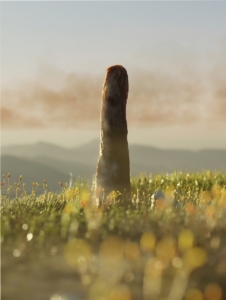
Artists impression of living Prototaxites. Artwork: Matt Humpage.
Wednesday 28 October, 7pm
Laura Cooper, University of Edinburgh
Prototaxites: a unique and extinct lineage of life from Scotland’s Rhynie chert
The Rhynie chert in Aberdeenshire is a 400 million year old fossil site that preserves, in exquisite detail, the first complex terrestrial ecosystem known in the fossil record. The species found here range from early land plants and arthropods, but also include a species that has been a paleontological mystery for over 160 years, Prototaxites. This talk will cover the longstanding debate over what Prototaxites was, and how the exceptionally preserved fossils of the Rhynie chert has helped us reach a solution to this mystery: that Prototaxites belonged to distinct lineage of complex life that has no living descendants today.
Wednesday 11 November, 7pm Ian Jackson, BGS (retired)
Wednesday 11 November, 7pm
Ian Jackson, BGS (retired)
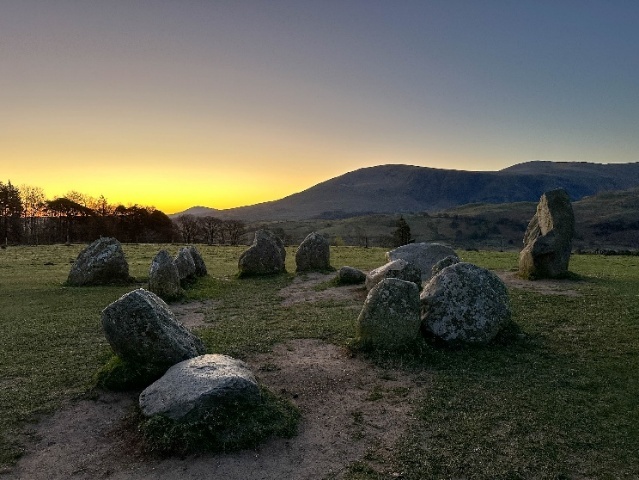
The influence of geology on prehistoric and Roman societies in the north of England
What did rocks ever do for our ancestors? The answer is pretty much everything. From giving shelter, to defining the positions of their defences and infrastructure, to providing the materials, implements and ritual objects that sustained them. For the prehistoric and Roman inhabitants of the north an understanding of the landscape, its rocks and their resources was not just desirable, it was essential; and their knowledge of these things was intimate.
The connections between rocks, the physical landscape and archaeology are persistent and pervasive. Can a better understanding of geology enrich and improve the effectiveness of archaeological research? This geologist emphatically believes it can and should. It can ensure greater fidelity and provide opportunities to add richness to our understanding of the recent past.
This talk is a geoscience-based perspective of the northern landscape and its archaeology; it raises some fundamental questions that have a bearing on the social, political and military narratives that have been and are currently promulgated.
Monday 16 November, 7pm Tim Fedak, Nova Scotia Museum
Monday 16 November, 7pm
Tim Fedak, Nova Scotia Museum
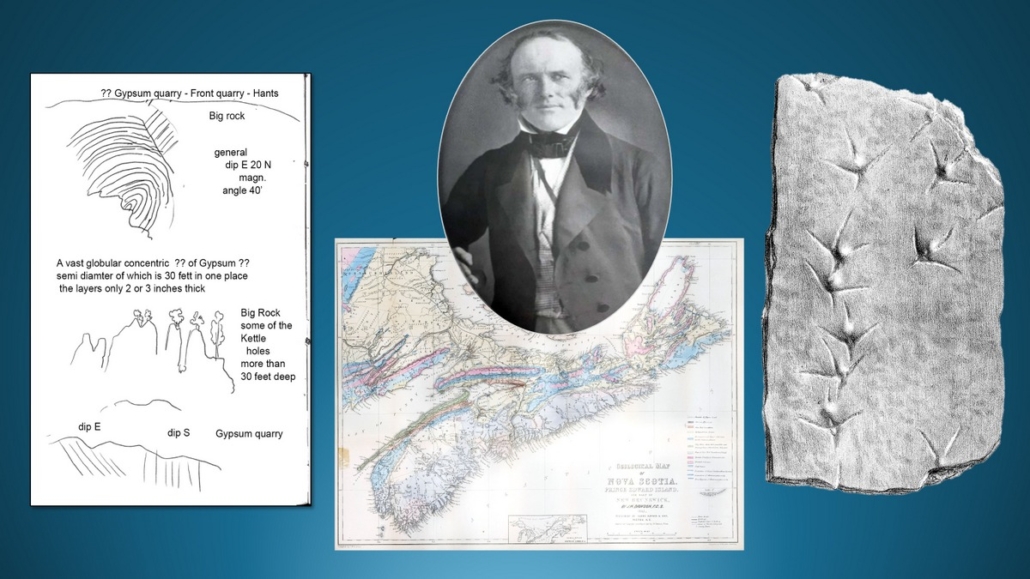
Retracing the Footprints and Notebooks of Charles Lyell in Nova Scotia’s Geoheritage
In the summer of 1842, Charles and Mary Lyell spent one-month travelling across Nova Scotia. Charles surveyed the region’s gypsum and coal seams, saw the famous Joggins fossil forest, and collected bird tracks from the Bay of Fundy mud flats. Today, Nova Scotia’s rich geoheritage is celebrated at the Joggins Fossil Cliffs UNESCO World Heritage Site and across the Cliffs of Fundy UNESCO Global Geopark. This talk will explain why Lyell thought Nova Scotia was so important and highlight the geologists he inspired.
This is a joint lecture together with the Edinburgh u3a Geology Group, and will be held at Paterson’s Land, Holyrood Road: please reserve your free ticket in advance.
Wednesday 25 November, 7pm Early Career Researchers
Wednesday 25 November, 7pm
Early Career Researchers
We are inviting a selection of early career researchers from Scottish universities to share their geoscience research in a series of short talks. The programme will be published on our website in advance.
This lecture will be preceded by an informal ‘pizza and pop’ session, from 6pm in the Grant Museum. All welcome: please book in advance.
Wednesday 9 December, 7pm Fellows’ Night
Wednesday 9 December, 7pm
Fellows’ Night
This meeting, close to the anniversary of the foundation of the Society, is a chance to meet other members informally, with refreshments served from 6.30pm, followed by a series of short talks given by members. If you would like to give a short talk on a subject of interest to members, please email Alastair Milne lectures@ edinburghgeolsoc.org.
Wednesday 13 January, 7pm Alex Brasier, Aberdeen University
Wednesday 13 January, 7pm
Alex Brasier, Aberdeen University
Searching for (and not always finding) fossil life on Earth: lessons for the study of Mars
If fossil life is found beyond Earth then it will be of microscopic microbes. Identifying rocks built by microbes is not easy. On Earth we look for layered rocks called stromatolites, but microscopy and geochemistry show that not all such layered rocks are products of living organisms. In Scotland there are some nice examples of genuine microbial stromatolites, including some living examples not far from Edinburgh. But there are also many rocks which have been interpreted as microbial stromatolites that aren’t, including in the billion-year-old lake deposits of the northwest highlands. Examples of stromatolites and imposters from across Scotland will be shown, with discussion of how to tell bonafide evidence for ancient biology from squashed sand ripples.
Wednesday 27 January, 7pm Steve Garrett, Geoscientist, guitarist and author
 Wednesday 27 January, 7pm
Steve Garrett, Geoscientist, guitarist and author
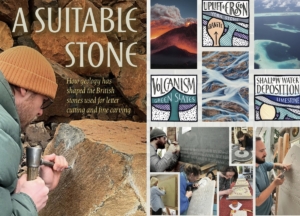
A Suitable Stone: How Geology has Shaped British Stones used for Letter Cutting and Fine Carving
A talk based on an inspiring book where Steve (the geologist) and Lida Lopes Cardozo Kindersley (the stone carver and letter cutter) look at a material in common: ancient rock. The talk explores connections between a geologist’s scientific perspective and a stone carver’s artistic vision. The key examples illustrate distinctive geological settings: Welsh Slates (deep water deposition), Lake District Slates (volcanism), sandstones (rivers and lakes) and limestones (shallow water deposition). The talk will also include PermoTriassic sandstones (desert dunes) as part of the Deep Time Trail, and diverse Scottish examples from the Canongate Wall. Engagingly presented and beautifully illustrated, the talk reflects the intimate, almost spiritual, relationship that these two disciplines share with rocks and stones.
This lecture will be preceded by an informal ‘pizza and pop’ session, from 6pm in the Grant Museum. All welcome: please book in advance.
Wednesday 10 February, 7pm Philippe Mongeau, University of Edinburgh
Wednesday 10 February, 7pm
Philippe Mongeau, University of Edinburgh
MIS/EGS Joint lecture: Sulphide trace-element signatures of mineralization styles in County Tyrone, Northern Ireland
The Caledonian-Appalachian orogenic belt hosts a large number of mineralised occurrences in arc and ophiolite sequences of varying type, age, host stratigraphy, magmatic affinity, and tectonic setting. World-class deposits occur on both sides of the Iapetus Suture upon Laurentian and Gondwanan affinity crust. Within these systems, regional-scale to intra- deposit controls on precious and critical metal enrichments are poorly understood. Further, the prospectivity for base, precious and critical metals varies significantly between mineralisation types, adding to the complexity of this issue.
The Tyrone Igneous Complex (TIC) of Northern Ireland represents an arc-ophiolite system that formed outboard of the Laurentian margin between the Early and Middle Ordovician. It has been recognized to be a direct correlative to the VMS-rich Annieopsquotch Accretionary Tract of Newfoundland, host to the world-class Buchan’s deposits. This study aims to improve the understanding of controls on mineralisation within the Caledonian-Appalachian orogeny, to provide a detailed assessment of their precious and critical metal potential and to contribute to their exploration and development efforts. We present new sulphide trace-element data (LA-ICP-MS) from mineralised occurrences combined with molybdenite and pyrite Re-Os geochronology, demonstrating that the mineralisation hosted in the TIC is considerably more diverse than previously thought.
We show that some occurrences previously interpreted as VMS are better characterised as porphyry, epithermal, intrusion-related and orogenic-style occurrences. These data, integrated with existing geochronological constraints, distinguish contrasting mineralisation styles and constrain distinct mineralising events associated with the evolving tectonic history of the area, placing these systems within a robust geodynamic framework and improving the targeting of prospective lithologies and structures.
Wednesday 24 February, 7pm Professor John Parnell, Aberdeen University
Wednesday 24 February, 7pm
Professor John Parnell, Aberdeen University
Clough Medal Lecure: From Millport to Mars: Interpretating chemical reduction in Scotland’s sandstones
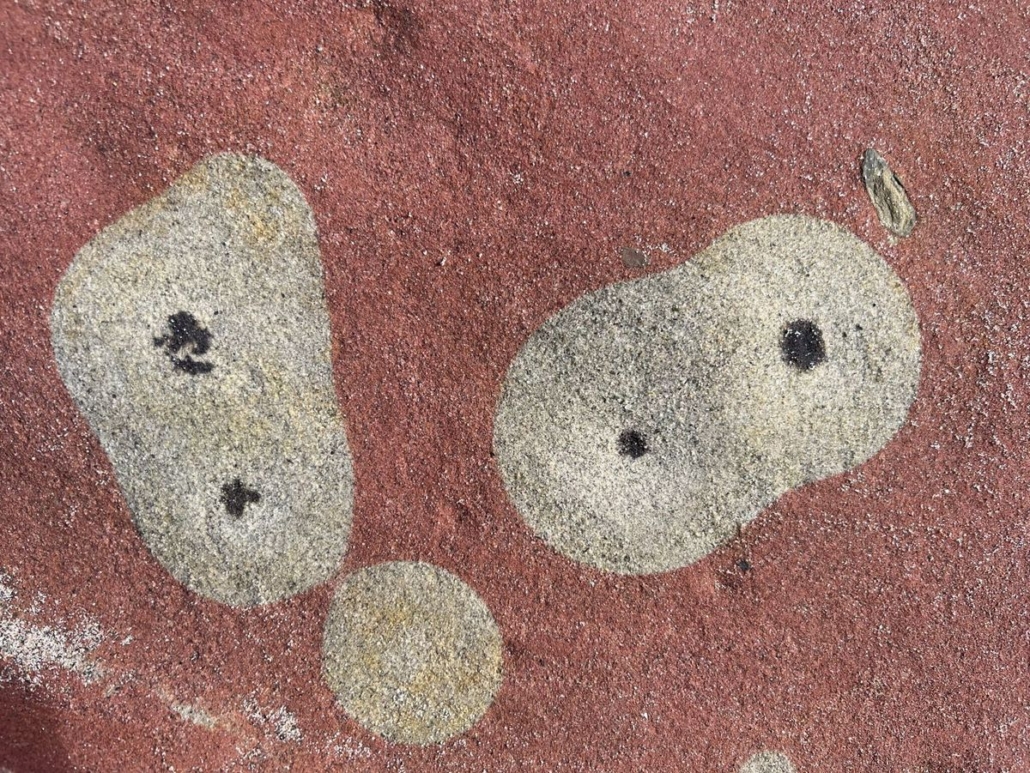
Red sandstone in Scotland, from Torridonian to Triassic, all contain reduction fronts, in common with continental sequences globally. The familiar reduction spots have now also been encountered on Mars. The possibility of a biological role for their formation makes the martian examples highly significant. One of the most intriguing characteristics is the range of elements that may be concentrated in the cores of reduction spheroids (spots), including rare metals and oxyanions vanadates, arsenates and phosphates. Some evidence suggests their composition reflects the chemistry of the rocks in the provenance of the sands, including two occurrences of spheroid-bound gold in Scotland. But not all spheroid cores are element concentrations formed during diagenesis. Other cores are instead detrital grains, which implies a different geometry of the reduction process. Current research focusses on the timing of the reduction, and controls on their metal chemistry and possible metal exploration potential.
Wednesday 10 March, 7pm David McInroy, BGS
Wednesday 10 March, 7pm
David McInroy, BGS
Scientific ocean drilling: highlights and examples of recent projects
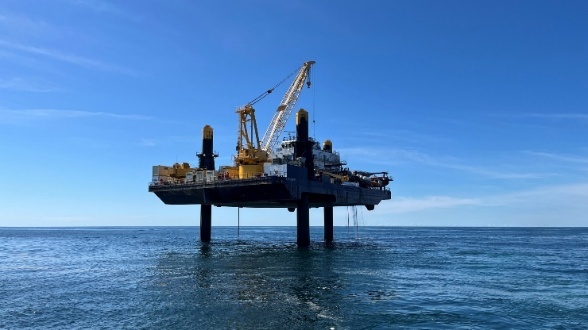
Scientific ocean drilling has explored Earth’s history and dynamics using marine research platforms since the 1960s. Over the decades since, various ocean drilling projects have cored below the sea floor to collect data and samples of sediment, rock, fluid and living organisms. These have been used to address some of the most fundamental questions about Earth’s evolution, most famously to confirm the unifying theory of plate tectonics. Since 2003, the British Geological Survey (BGS) has been an important member of the scientific ocean drilling community, operating mission-specific platforms to tackle niche and hard-to-reach geological targets. Over this time, the BGS and its partners have implemented 11 scientific ocean drilling projects in 7 different oceans and seas. These operations capitalised on alternative platforms and methods, and enabled the scientific community to access new geographical areas and new geological targets. Diverse coring technologies were deployed, and equally diverse were the environments in which these projects took place – from the ice-covered Arctic Ocean to the tropical seas of the Great Barrier Reef, and from the shallow waters of the Yucatan shelf to the ultra-deep hadal depths of the Japan Trench. In this lecture I will introduce the history of scientific ocean drilling, and highlight some the projects implemented by the BGS as part of the International Ocean Drilling Programme and its predecessors.
Wednesday 24 March, AGM 7pm, Lecture 7.30pm Professor Murray Gray, Queen Mary University, London
 Wednesday 24 March, AGM 7pm, Lecture 7.30pm Professor Murray Gray, Queen Mary University, London
Geodiversity: redundant term or significant geological paradigm?
The Australian geologists Margaret Brocx and Viv Semeniuk have argued that “the term geodiversity should not be used to mean ‘diversity of all things geological’ because the term geology is broad enough in scope and scale…to carry that implication”. They therefore regard geodiversity as a redundant term and portray it as:
• separate from the other ‘Gs’ (e.g. geoheritage, geoconservation, geotourism, etc.);
• related (only) to biodiversity;
• regional or local in scale.
This talk will argue that none of these three points apply and that instead geodiversity is:
• absolutely central to all the ‘Gs’;
• related to much more than biodiversityimportant though that is;
• global as well as regional or local in scale, just as biodiversity is.
I now regard geodiversity as short for geoscientific diversity as it includes geomorphology, soils and hydrological features as well as geology. Using examples, I will seek to demonstrate that use of the concept since its introduction in the 1990s, following adoption of the Convention on Biological Diversity at the 1992 Earth Summit in Rio de Janeiro, has led to many new insights, new avenues of research and new results that mean that it should now be regarded as a significant geological paradigm rather than a redundant term.
This lecture will be preceded by an informal ‘pizza and pop’ session, from 6pm in the Grant Museum. All welcome: please book in advance.
EGS Recorded Lectures 2026-27
Our YouTube Channel | Lectures Playlist
 Subscribe to EGS YouTube channel

EGS Recorded Lectures 2025-26
Our YouTube Channel | Lectures Playlist