Hutton's Section, Salisbury Crags

Re-visiting Hutton’s Section – Salisbury Crags

As we approach the 300th anniversary of James Hutton’s birth, I thought members might be interested to know more of plans by Historic Environment Scotland to re-open access to the section made famous by James Hutton on Salisbury Crags.

Hutton's Section, Salisbury Crags

Hutton’s Section, Salisbury Crags.  © Alison Tymon

As I am sure many of you are aware, access has been restricted know for some nearly 8 years.  A campaign to re-open part at least of the Radical Road has been ongoing and EGS has been involved with discussions with Historic Environment Scotland and other interested parties.

A very belated planning application in 2026 for the fence line to be moved is progressing through the planning process.  However, recognising the importance of Hutton’s section at the Tercentenary of his birth, there are plans to allow access to Hutton’s Section and the South Quarry at the start of June. The gates will be open each day, there will be HES rangers on duty: you need to book in advance for one-hour slots from Saturday 30 May to Sunday 14 June, 10am to 6pm.

Book here

This photograph was taken by Alison Tymon (EGS Honorary Fellow) back in 2017. Some further details on the exposure at the quarry section is given here.  This page also contains a number of photographs taken on a sunny day back in 2013.

For one, I will be joining the queue, as I’ve only visited the site once before. We’re told that following a recent spring clean, the section is in good condition. See you there!

More updates on the access dates and times will be posted here and sent to EGS members by email in early June 2026.

Neil Mackenzie, Honorary Secretary

Meeting young Mr Hutton

The Edinburgh Geological Society’s Introducing James Hutton event took place at Dynamic Earth on 6 October 2025.  The event also launched the Tercentenary celebrations for 2026, marking 300 years since Hutton’s birth on 3 June 1726.  A large crowd of over 150 people attended this event, and we heard from three guest speakers; Prof Colin Campbell (CEO, James Hutton Institute), Dr Rachel Walcott (Head of Mineral, Meteorite and Rock collections at the National Museums Scotland) and Dr Angus Miller (Promotions Coordinator, EGS).  Our compere for the evening was Dr Hermione Cockburn (Trustee, National Museums Scotland).

A highlight of the evening was a visit from young Mr Hutton, aged nineteen in 1745 – ably played by Edinburgh actor Danny Gorringe.  We learnt much about his time in Edinburgh, his family circumstances, his ambitions and plans that might lay ahead for him.

The Tercentenary celebrations, including the new Deep Time Trail at Siccar Point, will be supported by our Crowdfunder appeal, which runs until the end of November.  All contributions to the appeal aimed to raise £75,000 will be duly welcomed. There are plans a foot for lectures, exhibitions and excursions during 2026.  Events will be held across Scotland, including in the village of Cockburnspath in the Scottish Borders.

Finally, the EGS President, Prof Mark Wilkinson took the microphone at the end of the evening to announce the awarding of two Honorary EGS Fellowships; the first to one of speakers on the evening, Prof Colin Campbell in recognition of his leadership in promoting James Hutton and the Tercentenary  and secondly, to musician Karine Polwart, in recognition of her encouragement of public interest in geology through music and writing.

Thank you to all the contributors and organisers behind the scenes who made this such a successful launch of the Tercentenary year.

C T Clough’s notebooks uncovered

Earlier this year an out of the blue contact from Rosslyn MacPhail (author of “From Fighting Napoleon to the Scottish Military Academy: The Life of Captain John Orr”) has uncovered a connection with C T Clough.  It came to light that Rossyln’s mother had helped a neighbour by the name of Flossie, who was Clough’s eldest daughter. In return for this help provided in later life, Flossie gifted the notebooks to Rosslyn’s mother.

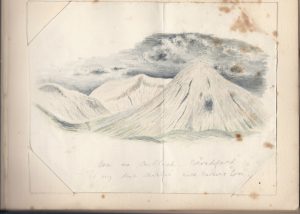
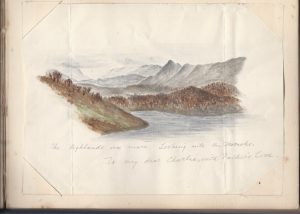
They contain little sketches done in the field, while Clough was working in Scotland around 1895.  Now Rosslyn has asked if she could donate these sketchbooks to the Edinburgh Geological Society. Some examples of the beautiful illustrations are shown here.  They are mainly of Highland scenes and are believed to cover the period 1895-97.

This is not first time that the Edinburgh Geological Society (EGS) has seen such illustrations, as the British Geological Survey archives also contain other sketches done by Clough around this time. You can view some of these here.

EGS is extremely honoured to receive these documents and is currently looking into the best way to preserve them. It is our intention to ensure that the diaries are scanned and a digital format is available through the EGS website and potentially other sites.

We would like to thank Rosslyn, for her foresight in wanting these sketch books to be shared as widely as possible.

Sir Roderick Murchison (1792-1871)

BGS GeoScenic archives and its hidden gems

Ben na Caillich, Broadford

If you get chance to take a look at the British Geological Survey’s GeoScenic archive its surprising what you can find.  A year or so ago, whilst on Clough Committee duties, Graham Leslie (Clough Committee Secretary) was kind enough to show members some images, which I thought you might like to be alerted too.  They were some water colour sketches and pencil drawings made by Dr. Charles T. Clough and sent in letters to his son Charles Durham Clough between 1895 – 1900.  At the time, Clough would have been on duties with the Geological Survey in Scotland and to whom he transferred from the England arm in 1884.  He would have done these sketches (probably as a form of relaxation whilst in isolation – imagine what that would be like?) but also to share with his son something of the geology of different parts of Scotland that he was visiting at the time.  A couple of of the images are presented here courtesy of the BGS archive.

The first is entitled “Ben na Caillich, Broadford”, which is one of Red Hills in the southern part of Skye.  The second sketch is of “The Highlands once more. Looking into the Trossachs.” and would seem to shows the forested area at the eastern end of Loch Katrine.

View of the Trossachs

If you would like to know more about Dr Charles T Clough – please turn to our Pioneers page for a quick biography of his life.

In preparing this article, I would wish to acknowledge the descendants of Charles Durham Clough, from whom the images have been copied.  Also the BGS’ GeoScenic archive which we are able to share because of the OpenGeoscience under Open Government Licence.

Finally, do have a good rootle around the archive for other hidden gems.  I am guessing that there are more out there and if you let me know, we can alert Fellows to other fascinating resources relating to Scotland’s geo-heritage.

Neil Mackenzie, Honorary Secretary of the Edinburgh Geological Society


Geological Pioneers

Alexander Rose (1781-1860)

Charles Lapworth plaque unveiled in the Borders

Charles Lapworth plaque unveiled in Galashiels

A plaque has been unveiled to commemorate the life and works of the eminent geologist Charles Lapworth LL.D., F.R.S. (1842-1920) at the old Episcopal School in Galashiels. The listed building now housing Border Council’s offices was originally the school where Lapworth was headmaster between 1864-75. He moved to the Borders to teach from his original home in Berkshire. He married Janet Sanderson in 1869 and had four children, three of whom were born in the school house.

The unveiling on 20th May 2019 was done by children of the local St Peter’s Primary school in Galashiels. The efforts to erect the plaque were made by retired local residents and geology enthusiasts, Malcolm Lindsay and David Adamson.

Lapworth is a name which is long associated with Southern Uplands of Scotland. He did his initial research while living locally, but it was not until he moved to Madras College, in St Andrews in 1875 to continue his teaching career that he began to publish his defining work on the distribution of extinct organisms called graptolites. In 1879, he suggested the name “Ordovician” to describe the period between the Cambrian and Silurian ages, a name which was duly accepted across the world. Sir Edward Bailey, the Director of the British Geological Society and Professor of Geology at Glasgow University, later described Lapworth’s interpretation as “one of the miracles of science” and later said that “Lapworth grew up to be, perhaps, the greatest geologist who ever lived”. This plaque is therefore a fitting commemoration to the important time spent by Lapworth both teaching and researching in the Borders.


Charles Thomas Clough (1852-1916)

James Hutton (1726-1797)