Hutton's Section, Salisbury Crags

Re-visiting Hutton’s Section – Salisbury Crags

As we approach the 300th anniversary of James Hutton’s birth, I thought members might be interested to know more of plans by Historic Environment Scotland to re-open access to the section made famous by James Hutton on Salisbury Crags.

Hutton's Section, Salisbury Crags

Hutton’s Section, Salisbury Crags.  © Alison Tymon

As I am sure many of you are aware, access has been restricted know for some nearly 8 years.  A campaign to re-open part at least of the Radical Road has been ongoing and EGS has been involved with discussions with Historic Environment Scotland and other interested parties.

A very belated planning application in 2026 for the fence line to be moved is progressing through the planning process.  However, recognising the importance of Hutton’s section at the Tercentenary of his birth, there are plans to allow access to Hutton’s Section and the South Quarry at the start of June. The gates will be open each day, there will be HES rangers on duty: you need to book in advance for one-hour slots from Saturday 30 May to Sunday 14 June, 10am to 6pm.

Book here

This photograph was taken by Alison Tymon (EGS Honorary Fellow) back in 2017. Some further details on the exposure at the quarry section is given here.  This page also contains a number of photographs taken on a sunny day back in 2013.

For one, I will be joining the queue, as I’ve only visited the site once before. We’re told that following a recent spring clean, the section is in good condition. See you there!

More updates on the access dates and times will be posted here and sent to EGS members by email in early June 2026.

Neil Mackenzie, Honorary Secretary

Fellows’ Night 2022 – No. 189!

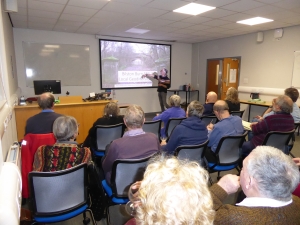
On 14th December 2022, the Edinburgh Geological Society held its 189th Fellows’ Night at the Grant Institute, University of Edinburgh. This meeting takes place each year, close to the anniversary of the foundation of the Society (on 6th December). 
The pandemic has meant that a “normal” Fellows’ Night has not taken place for a few years now.

This year we were determined to be “normal” again and so an in-person event was held at which a series of short talks were given by members and some refreshments enjoyed by all.
Four speakers were lined up for this event, but first Mike Browne (acting EGS President) gave a thank you to both Alison and Barry Tymon for their contribution to geoconservation in the Midlothian and Scottish Borders recently, and in Yorkshire previously. This work has added significantly to the total of number of local sites recognised for their geological interest across the Lothian and Borders region to 166.

The talks kicked off with Angus Millar (EGS Promotion Coordinator) (and his dog) taking up a challenge to visit 30 geoconservation sites in the month of November, and yes, he achieved this – 32 in fact and despite wet weather. Sites visited varied from Kilspindie beach erratics to the Eildon Hills, and Carlops glacial drainage channels to River Clyde oxbow lochs and active meanders. A fascinating demonstration of the breadth of geological sites on our doorsteps.

Second up was Bob Gatliff who updated Fellows on Siccar Point activities in 2022 – the embarking on the process of getting UNESCO heritage status for Hutton’s Unconformity, obtaining widespread support for the project and recognition by IUGS of Siccar Point being one of the first one hundred sites recognised for its geological heritage significance.

Thirdly, Mark Williamson (University of Edinburgh) described his geological reconnaissance of the Bilston Glen SSSI as a location for future undergraduate student visits. Its combination of mining heritage and exposures of the Lower Carboniferous (not always so clear) was described.

Finally, we heard from Prof James Floyd on his “Ships of stones” which described some fascinating collections of ornamental decoration using geologies from around the world. He explained how he discovered these treasures when engaged to give lectures on cruise ships. This had led to the discovery that not only was the best geology to be found at the islands they visited but that on board many of the ships was a wealth of geological interest as well (sadly not being recognised by many of the crew members and passengers).

In conclusion, I think everyone who attended came away with the feeling that geology surrounds us everywhere and that although not everywhere has that notice board just yet, there are a huge number of resources available through the EGS website (the Autumn Members’ Challenge is a good place to start).

We look forward to many more Fellows’ Nights in the future.

Merry Christmas and a Happy New Year,

Neil Mackenzie, EGS Secretary.