
Fieldwork Grants from the Clough and Mykura Funds
Grants from these funds are available to support geological field work at home or abroad.
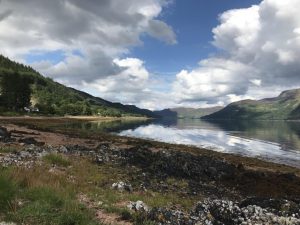 2020 Ratagain Complex, NW Highlands
Anya Lawrence, University of Birmingham
After a summer spent in lockdown due to the COVID-19 pandemic, in late August 2020 I was able to undertake my long-awaited final field session at the Ratagain Complex in the NW Scottish Highlands with support from the Edinburgh Geological Society.
As a disabled PhD student with Asperger’s syndrome (an autism spectrum disorder) I rely on my parent carers to help me manage my everyday life. The grant awarded to me by the Edinburgh Geological Society enabled both myself and my parent carers to complete my detailed sampling of the Ratagain Complex and bring the total haul for the project up to the milestone figure of 100 block samples.
Future work will include detailed geochemical and structural analysis of the 100 samples that I have gathered across four field sessions at Ratagain. The geochemical methods used will be X-Ray Fluorescence (XRF) spectrometry and Inductively coupled plasma mass spectrometry (ICP-MS), whilst the structural studies will involve the anisotropy of magnetic susceptibility (AMS) and thermomagnetic analysis, both of which are powerful indirect tools used to study intrusive rocks like granites that often lack visible fabrics.
Read Anya’s full report on the fieldwork and the Ratagain Complex
2019 New Insights into Gardar Rifting: Geological Mapping of Tuttutooq, SW Greenland
Report (pdf file, 3.77 MB) from a group of five undergraduate Geologists from the University of St Andrews who undertook a six-week geological mapping expedition to the island of Tuttutooq, south-west Greenland, during the summer of 2019.
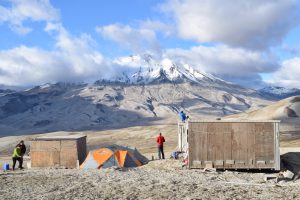
Figure 1 – Our campsite in the Valley of Ten Thousand Smokes, looking towards Mount Griggs, Bob Gooday.
2017 Mount Katmai and the Valley of Ten Thousand Smokes
Bob Gooday, Cardiff University
In June 2017, support from the Edinburgh Geological Society allowed me to participate in the International Volcanological Summer School in Katmai National Park, Alaska. This involved staying in the Valley of Ten Thousand Smokes for ten days, looking at volcanic features in the Valley and the surrounding Katmai Cluster of volcanoes. The Katmai-Novarupta eruption in 1912 was the largest on Earth in the twentieth century, and completely filled a nearby valley with pyroclastic deposits. These deposits sustained intense fumarolic activity for several years, giving the valley its name.
During our stay in the Valley, we looked at the pyroclastic deposits and landforms created by the 1912 eruption, which have been largely untouched by erosion or vegetation. The highlight of the trip was climbing to the rim of the crater at the top of Mount Katmai. The eruption itself happened at Novarupta, 10 km to the west, but the emptying of the magma chamber below Katmai caused the mountain to collapse, forming a caldera 4 km across.
Observation of this caldera, and discussion of the processes at work in the accompanying eruption, have helped me with my PhD work on a similar-sized, but much older, caldera system on Arran, western Scotland.
Download a more detailed article written by Bob about this project.
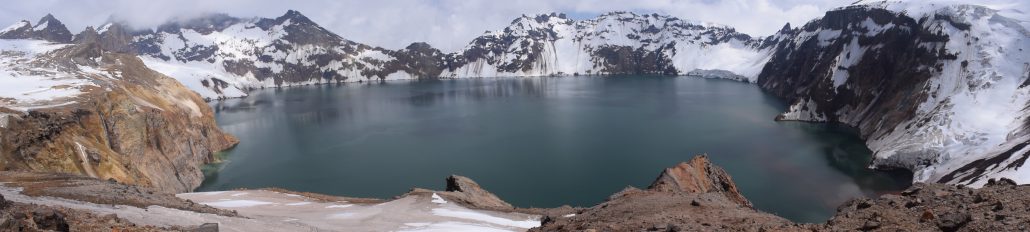
Figure 2 – The caldera at the summit of Mount Katmai, formed during the 1912 eruption. Bob Gooday.
2015 The Central Layered Intrusion, Isle of Rum, NW Scotland
Luke Hepworth, Keele University
 With the support of the Edinburgh Geological Society I was able to spend some time in addition to my planned field season exploring the Central Layered Intrusion (CLI) as part of the Rum Layered Suite in NW Scotland.
The CLI is perhaps the most poorly studied of the Rum Layered Suite, and the most lithologically complex, being composed of juxtaposed cumulate rocks such as peridotite (including harrisite), troctolite, and gabbro without pervasive layering (see image above). The CLI occurs closest to the Long Loch Fault in the centre of the intrusion, the presumed source of the Rum magmas which was purportedly active during the formation of the layered complex. As such, brecciation and deformation is widespread with metre sized blocks of foreign cumulate found incorporated within peridotites and troctolites. The purpose of additional study as part of my current PhD project was to investigate the occurrence of Cr-spinel seams within the CLI, which was actively deforming during its formation.
 A primary focus of my research is to elucidate the magma chamber dynamics within the Rum Intrusion using ubiquitous platiniferous Cr-spinel seams found within peridotite cumulates. My previous investigation has focused on the well-layered Eastern (ELI) and Western Layered Intrusions (WLI). As Cr-spinel seams typically represent a replenishment event in layered intrusions, numerous Cr-spinel seams found within peridotite cumulates suggest multiple and potentially much smaller replenishment events. These Cr-spinel seams are also associated with harrisite, an unusual olivine cumulate composed of highly skeletal olivine crystals, comprising a key example of in situ crystallisation in layered intrusions. This lithology has also been suggested to represent intrusive replenishment into the crystal mush. The association with this intrusive and in situ lithology strongly suggests the platiniferous Cr-spinel seams also formed in situ, opposed to gravity settling commonly advocated in layered intrusions. The crystallisation of these seams in situ within the crystal mush has significant implications to the petrogenesis of Cr-spinel seams and associated platinum mineralisation in much larger layered intrusions such as the Stillwater Complex (Montana, USA), or the Bushveld Complex (South Africa) which hosts world class deposits of platinum mineralisation, and where intrusive replenishment has not yet been explored fully.
While not as common as Cr-spinel seams found in the ELI and WLI, Cr-spinel seams do occur within the CLI, also hosted in peridotite. Perhaps not unexpectedly, Cr-spinel seams found within the unlayered CLI are not oriented in a particular direction as in the ELI or WLI where layering is strongly defined. Instead, these seams appear vertical, sub-vertical, or in concentrated clots within coarse grained harrisitic peridotite (see images above).
Results of sampling and field investigation during 2015 will be incorporated into my current study to provide an intriguing parallel to well-layered peridotite cumulates and investigate the effects of magmatic deformation on the petrogenesis of Cr-spinel seams an associated platinum concentration in the Rum Layered Intrusion.