Contains public sector information licensed under the Open Government Licence v3.0.
On the 6th of February, a joint lecture of the Mining Institute of Scotland (MIS) and the Edinburgh Geological Society (EGS) was held at the Grant Institute of Geology , University of Edinburgh.
Dr Hugh Barron of the British Geological Survey (BGS, Scotland) gave us an overview of the Glasgow Geothermal Energy Research Field Site GGERFS, a research facility run by BGS Scotland and the Natural Environment Research Council (NERC), who also carry part of the funding.
Why geothermal energy?
Currently, only about 20% of Scotland’s total energy consumption is covered by renewable energies. It doesn’t sound impressive – and certainly we hope to do better in the future – still, compared with the rest of the UK, Scotland is remarkably successful in its implementation of renewable energies. And while our heat energy consumption is on average 3% higher than in the other parts of Britain (information accompanied by sympathetic laughter from the audience), compared with 2006 it has been reduced by impressive 30%.
New technologies may extend our exploitation of fossil fuels but they remain a finite resource. And considering the current rate of Global Warming it is even more important to find ways of generating energy which are low in CO2 and / or CH4 emissions. Geothermal energy clearly offers an interesting alternative.
Geothermal energy – for most people this conjures images of Iceland, where active volcanism provides subterranean heat, and hot springs are used in ingenious and spectacular ways. How could Scotland compare? For while our geology speaks of a rich volcanic past, by now our volcanoes are all extinct; eroded remnants of former explosive power.
However, geothermal energy is not just a question of how hot, but also of how much – relatively small differences in temperature over a large body of water still contain huge amounts of energy.
The tricky part is to extract this energy – and to make it widely available. As of now, it’s neither commercially nor technologically feasible to install a geothermal system for a single household property. For the most part, facilities are installed in large edifices or building complexes.
Projects of this kind do exist: the town of Heerlen (Netherlands) has been running a minewater scheme since 2008. In Scotland, facilities were installed in Shettleston (Glasgow), and in Lumphinans (Fife). These two projects had to be stopped in the meantime, due to problems with clogging (Shettleston) and a lack of qualified personnel for maintenance (Lumphinans).
This shows why it is so important to run a research program to find solutions for those technical problems, and to create the base for reliable and easy to run systems.
An image from the public exhibition in Dalmarnock, Glasgow (September 2015), which presented the plans for the geothermal energy research field site. Staff from the BGS explained the research and answered the visitors’ questions:
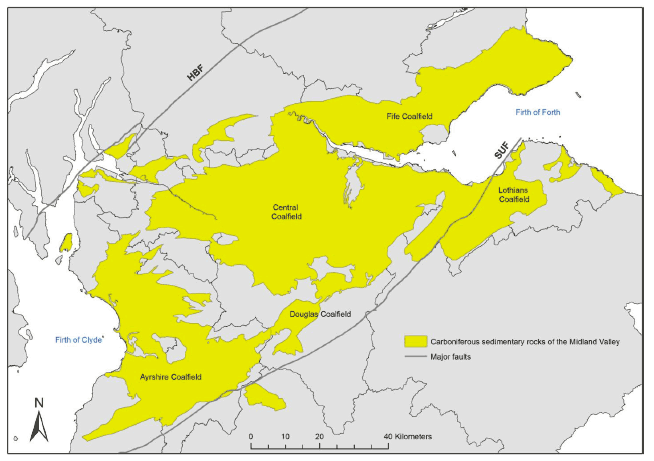
Between the Highland Boundary Fault in the North and the Southern Uplands Fault in the South, we find five large coal mining areas:
The Fife Coalfield
The Central Coalfield
The Lothians Coalfield (which crosses the Southern Uplands Fault in an eastwards direction)
The Douglas Coalfield
The Ayrshire Coalfield
https://www.gov.scot/crown-copyright/
Thousands of miners worked for centuries to extract the coal. What better way to honour their hard and dangerous work, than by re-using their constructions to improve our lives, protect our environment, and increase our knowledge?
Recycling
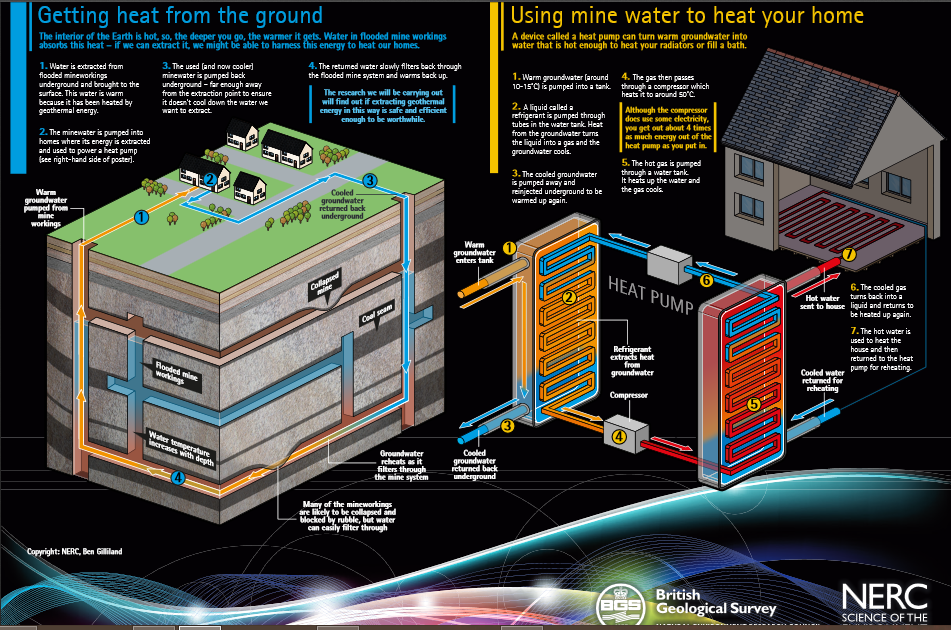
To use old coal mines offers a couple of advantages. The mines reach down to a depth of ~ 900 m, the shafts allow easy access to warm water with a maximum temperature of ca. 37° C. Records of these mines are still held by the BGS, and can offer information about promising future sites.
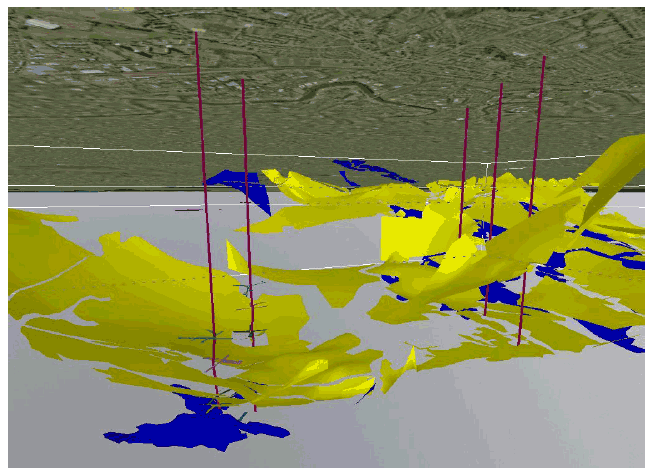
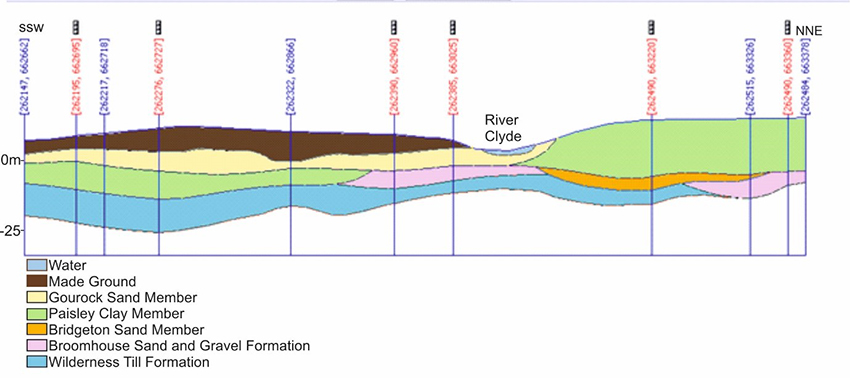
An interesting 3D view of the faulted and folded coal seams under the East End of Glasgow is provided by the Scottish Government:
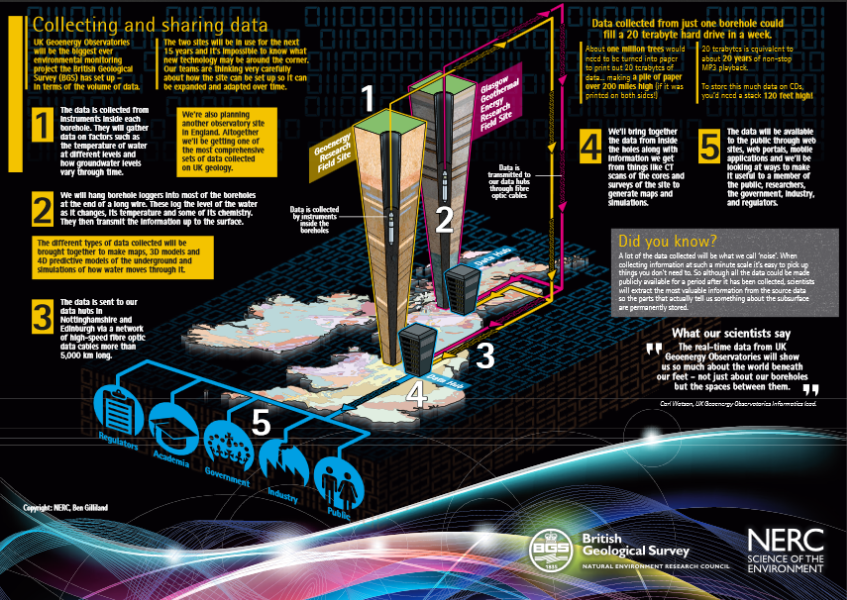
The research is realised via the UK Geoenergy Observatories Project.
The project was commissioned by NERC, while BGS will carry out the research infrastructure and operate the facilities.
Two research sites have been created, with the aim to
Independently monitor underground energy technologies
Gather scientific evidence on new and established energy and storage technology to increase efficiency and sustainability
Gain a world-class understanding that could support management and regulation
Develop new, exportable technologies
The project’s timeline is set for 15 years, the duration of its last stage as a research facility will depend on the interest shown by the academic community.
There are many benefits to be gained from a dedicated research site.
First, as fracking has shown, we need to learn in advance what impact energy extraction might have on geology and environment. All the more, since effects cannot be directly observed, and intervention deep in the bedrock would be difficult or even impossible.
The people living close to these sites have a right to know what effects any project could have on their lives. As long as this information cannot be provided, the new technology isn’t likely to be accepted.
Secondly, this is an opportunity for gathering academics working in different fields. As astronomical missions are shared by many research teams, this could become a site where scientists can co-work in a professional environment, and share information across the borders of research interest or nationality.
Finally, besides technology, these days it’s mainly expertise that becomes a commodity. And more than money can be gained: to share knowledge is also an important way to connect people all over the world. Also, it’s in our own interest to help other countries to reduce their CO2 emissions, as the effects of Global Warming caused in one country won’t stop at the borders of the next.
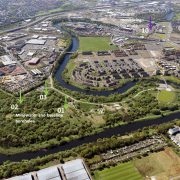
The site itself is situated in the Cuningar Woodland Park, a community park which successfully managed to encourage usage by the local community. Its quite charming welcome sign at the entrance, a quote from Dr Seuss
“Welcome…’If you never did you should. These things are fun and fun is good.'”
could apply to geology, as well as to all other sciences.
Soil and bedrock at the site are a mixture of both natural and man-made formations.
Not all planned boreholes could be installed. The ‘surviving’ two include a weather station, gas probes, sensors for CO2 and CH4, and an active satellite based inSAR ground motion sensor. Seismometers are included as well ( in fact, they had been installed just the day before the talk). They are part of the UK seismic monitoring network.
The data acquisition in total includes environmental monitoring, soil chemistry, hydro-geochemistry, noise, and ecology.
The Future
The project is not meant to produce enough heat to cover all its costs, rather it is planned to finance itself through its use as a research site.
This research might include measuring the impact of the geothermal technology on the local environment, new technology, and even defining a base for legal and regulatory framework (as of now, there is no regulatory regime for geothermal technology in Scotland or the UK). In order to turn geothermal energy and heat into a profitable as well as beneficial industry, the extent of all related costs has to be established.
Research topics envisaged so far:
Faulting and subsurface flow partitioning
Chemical and heat tracer tests
Flow rates and sustainability of heat yields
Thermal breakthrough
Subsurface to surface impacts
Strategies to minimise clogging
Geo-microbiology
New technologies
An online data portal to make the results available for scientists and engineers world wide is planned.
The lecture offered an interesting view on a so far little-explored way of creating energy in Scotland. This project combines modern technology with the past – the constructions as well as the documentation held by the BGS – to add another piece to the mosaic of modern, decentralised energy production. The knowledge gained here can help to facilitate the use of geothermal energy even on a modest scale. The smaller and simpler the technology, the wider the possible application world wide.
Thanks & Acknowledgement
Gratitude is owed to Dr Barron for holding this lecture. He gave a clear overview of the project, its background, goals, challenges and future. He also kindly answered many follow-up questions at the traditional after-talk-tea at the Cockburn Geological Museum.
Links
Contact Dr. Barron
hfb@bgs.ac.uk
British Geological Survey
https://www.bgs.ac.uk
NERC
http://www.nerc.ac.uk/
Grant Institute of Geology
https://www.ed.ac.uk/geosciences
University of Edinburgh
https://www.ed.ac.uk/
Glasgow Geothermal Energy Research Field Site GGERFS
https://www.bgs.ac.uk/research/energy/esios/glasgow/
Potential for deep geothermal energy in Scotland: study volume 2
https://www.gov.scot/publications/study-potential-deep-geothermal-energy-scotland-volume-2/pages/9/
Open Government Licence for public sector information
http://www.nationalarchives.gov.uk/doc/open-government-licence/version/3/
https://edinburghgeolsoc.org/wp-content/uploads/2019/05/cuningarLoopClydeGatewayCopyright-480x480.jpg532800adminhttps://edinburghgeolsoc.org/wp-content/uploads/2017/01/Edinburgh_Geological_Society_Logo_White_Slogan-1.pngadmin2019-05-07 18:41:072019-05-07 18:41:07Recycling the Past to Research for the Future: the Glasgow Geothermal Energy Research Field Site (GGERFS)
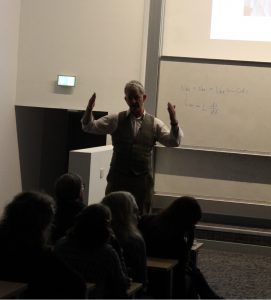
On March 6th Frank Rennie, Professor of Professional Rural Development at Lews Castle College, UHI, gave a fascinating lecture and comprehensive introductory tour of the geology of the Isle of Lewis.
The geology of the Lewisian gneisses is complicated, but is so much more than simply boring monotypic banded rocks, and this lecture highlighted features to look out for in the landscape.
Despite being a long-time member of the Edinburgh Geological Society, Prof. Renniehad never made it to one of our lectures so far. It was our pleasure finally to welcome him, even if it took him to be the presenter himself in order to make it here…
Right at the start we’d like to invite our readers to have a look at the slides Professor Rennie provided for this talk and kindly shared online:
“Far, far below the deepest delving of the Dwarves, the world is gnawed by nameless things. Even Sauron knows them not. They are older than he. Now I have walked there, but I will bring no report to darken the light of day.” [1]
If there are such ‘nameless things’, and if they have been down at the roots of the mountains since the beginning of time, at about 3.2 billion years ago they would have witnessed (and likely munched on) the earliest forms of what we now know as Lewisian gneisses.
These rocks formed in the root zone of a gigantic mountain range. What we see today are the worn-down roots of a once-mighty mountain belt. This is the end state of mountain building which, millions of years in the future, even the young Alps and the middle-aged Appalachians will approach.
The rocks formed 35 – 40 km deep in the crust in a highly metamorphic environment, at temperatures of ~ 900° C and a pressure of ~10 kbar. At the time of their formation, the rocks were buried in the Earth’s crust positioned at the South Pole.
But while their formation started at 3.2 billion years ago, the gneisses as a whole spanned a period of roughly 1.5 billion years, a detail often overlooked when the immense age of these rocks is mentioned.
In order to make this inconceivable time span more tangible, Professor Rennie used one year to represent the whole of Deep Time. In this comparison the Outer Hebrides formed between February and June, while the Lewisian gneisses appeared around May. Fortunately, we can be quite sure that no creature had them for elevenses, for on this time-scale even the first fish appeared only in November.
Lewisian Gneiss and Where to Find Them
Three types of Lewisian gneisses can be found: metasediments, granitic gneisses and undifferentiated gneiss which cannot be placed in either category, and is often referred to as ‘banded’ or ‘grey’ gneiss. This latter is a highly dense rock that doesn’t break or weather easily. The thin section (see presentation) shows crystals elongated by pressure on the matrix. Other tension-related phenomena, for example boudins, or pods, occur as well.
The gneiss may be the rock on which Lewis rests for the most part, but most of it is hidden under grass, peat and other surface covers. Outcrops are mostly found along rivers or at the coast.
At Ness, a flaggy and fractured metasedimentary assemblage can be seen, while at Scourie a dyke shows in the form of its absence – the intrusion building the dyke weathered easier than the grey gneiss, which is much less susceptible to erosion. In Dail Beag Precambrian granites cut through the gneiss.
The landscape of the Outer Hebrides both directed and was shaped by ice flow during the last Ice Age. Signs of this can be seen in Sough Galson or in the interesting raised beach over glacial till at Habost.
No More Mr Gneiss Guy
The geology of Lewis and its gneisses is much more complicated than many are aware of or care to learn about. On the other hand, there is demand for education – local people as well as visitors show their interest. Professor Rennie told of rocks brought to him for identification, and requests to lead geology tours around Lewis.
Maybe, with the help of the geological institutions in Scotland and the new Scottish Geology Trust, geological ‘wildlife safaris’ and / or rock identification events similar to those held for mushrooms (albeit with a less dangerous background) could be organised in the future.
It’s no use going back to yesterday, because I was a different rock then…
Many are aware that Lewisian geology is more akin to that of Greenland than mainland Scotland. The question, however, why the Atlantic opened to the West of Lewis, instead of separating it from Scotland and keeping it nice and tidy with Greenland, could not be answered. This is a conundrum for future geologists to research and resolve.
~~~~~~~~~~~~~~~~~~~~~~~~~~~~~~~~~~~~~~~~~~~
Our heartfelt thanks go to Professor Rennie for investing time and effort in both this highly interesting lecture and his long-awaited visit to Edinburgh.
~~~~~~~~~~~~~~~~~~~~~~~~~~~~~~~~~~~~~~~~~~~
Sources:
[1] J.R.R. Tolkien, The Lord of the Rings, The Two Towers, “The White Rider”
https://edinburghgeolsoc.org/wp-content/uploads/2019/04/IMG_6220_small.jpg721999adminhttps://edinburghgeolsoc.org/wp-content/uploads/2017/01/Edinburgh_Geological_Society_Logo_White_Slogan-1.pngadmin2019-04-10 22:11:402019-04-29 17:17:28A Lewisian Perspective: The basement of the Earth
We may request cookies to be set on your device. We use cookies to let us know when you visit our website and how you interact with it. This enables us to keep improving it.
Click on the different category headings to find out more. You can also change some of your preferences there. Note that blocking some types of cookies may affect your browsing experience and the services we are able to offer.
Essential Website Cookies
These cookies are needed for us to provide our website services and features as intended.
Rejecting them is likely to affect how our site functions for you. Cookies can always be blocked or deleted by changing your browser settings. However, this will always prompt you to accept/reject cookies whenever you revisit our site.
We respect your wish to refuse cookies, but to avoid asking you repeatedly kindly allow us to place a cookie to store that preference. You are free to opt-out any time or opt-in for other cookies to get a better experience. When you refuse cookies we will remove all set cookies in our domain.
We provide you with a list of stored cookies on your computer in our domain for you to check. Note, for security reasons, we are unable to show or modify cookies from other domains. You can check those in your browser security settings.
Google Analytics Cookies
These cookies collect information that is used either in aggregate form to help us understand how our website is being used or how effective our marketing campaigns are, or to help us customize our website and application for you in order to enhance your experience.
If you do not want that we track your visit to our site you can disable tracking in your browser here:
Other external services
We also use different external services like Google Webfonts, Google Maps, and external Video providers. Since these providers may collect personal data like your IP address we allow you to block them here. Please be aware that this might heavily reduce the functionality and appearance of our site. Changes will take effect once you reload the page.
Google Webfont Settings:
Google Map Settings:
Google reCaptcha Settings:
Vimeo and Youtube video embeds:
Privacy Policy
You can read about our cookies and privacy settings in detail on our Privacy Policy Page.

 Thousands of miners worked for centuries to extract the coal. What better way to honour their hard and dangerous work, than by re-using their constructions to improve our lives, protect our environment, and increase our knowledge?
 From:
Potential for deep geothermal energy in Scotland: study volume 2
From:
Potential for deep geothermal energy in Scotland: study volume 2
 The lecture offered an interesting view on a so far little-explored way of creating energy in Scotland. This project combines modern technology with the past – the constructions as well as the documentation held by the BGS – to add another piece to the mosaic of modern, decentralised energy production. The knowledge gained here can help to facilitate the use of geothermal energy even on a modest scale. The smaller and simpler the technology, the wider the possible application world wide.