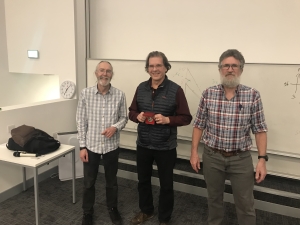
Tony being presented with Clough Medal 2023-24
Our annual Clough Medal lecture took place on 28th February at the Grant Institute, Kings Buildings Campus, University of Edinburgh and also broadcast online. The audience for this years’ lecture was well over 100 (50+ in person and 54 on line). Whether the fact that the lecture was preceded by a “pizza and pop” event, kindly supported by a donation from an EGS Fellow, or whether it was cohort of Tony Prave’s supporters from the University of St Andrews, it did make for a great atmosphere on the evening.
Graham Leslie, Chair of the Clough Committee had the honours of explaining that the Clough Medal was established in 1935 and is given each year to a person who has contributed to a geologist whose original work has materially increased the knowledge of the geology of Scotland and/or the north of England, or one working in Scotland or the north of England who has significantly advanced the knowledge of any aspect of geology.
The medallist for 2023/24 was Professor Antony (Tony) Prave (School of Earth and Environmental Sciences, University of St Andrews) who gave a lecture entitled “There is nothing left to learn about this scrap of NW Europe”. He was presented with his medal by Mark Wilkinson, President of Edinburgh Geological Society.
Tony Prave started his academic career at The City University of New York in USA, before coming to the University of St Andrews in 1996 as a Senior Lecturer. For the subsequent 27 years, he has carried a wide range of research; with two programmes having had particular scientific impact: that concerned with the Neoproterozoic, and that with the Palaeoproterozoic. In each case the modus operandi has been the same: (1) meticulous and painstaking fieldwork conducted from a base of deep theoretical knowledge and an open mind; (2) careful screening of samples through petrography and geochemistry; (3) advanced isotope geochemical analyses; and (4) imaginative interpretation of the data within the geological and field context. The impact of his published oeuvre has been substantial and paradigm changing.
Tony has brought new ideas, fresh thinking and novel approaches to study of the Dalradian sequences in both Scotland and Ireland. The complex geological – and especially metamorphic – history and the paucity of robust geochronology resulted in a wealth of opinion and speculation, sometimes dressed up as coherent theory. One grizzled veteran is known to have grouched about Prave’s “Olympian disregard of 40 years of research on the Dalradian”, but as his lecture demonstrated, it was merely that he pointed out that the evidence-base for previous thinking was weak. Instead, Tony conceived fresh ideas from carefully selected samples of carbonate that might be suitable for carbon isotope chemostratigraphy – pace the adherents of metamorphic overprint – and in this he was spectacularly vindicated (Prave et al. 2009 J.Geol.Soc.Lond.). He has also had significant projects in Namibia and Death Valley, and was a central player with Simone Kasemann and others in applying novel isotopic approaches (including boron, calcium and magnesium isotope ratios) to some classic “Snowball Earth” sections in Namibia.
For the Palaeoproterozoic and the consequences of the Great Oxidation Event (oxygenation of the Earth’s surface) around 2.4Ga, Tony thorough work originated at the Loch Maree Group, became a key player in the multinational Fennoscandia Arctic Russia – Drilling Early Earth Project (FAR-DEEP). He was closely involved in successful funding initiatives to ICDP and NERC and was co-editor on three substantial volumes (each exceeding 500 pages) published by Springer in 2012/13. He followed this success with a similar-scale international drilling project on equivalent age sequences in Gabon.
The vote of thanks was given by Prof Tony Fallick FRSE, FRSA, FMinSoc (Clough Medal, 2013/14). He paid tribute to Tony’s perseverance in proving the doubters wrong on so many occasions and to ensuring that it’s the rocks that cannot lie. It had been Tony’s ideas and drive that had brought success to the excellent teams both at University of St Andrews and also further afield, and in so doing he is a truly worthy recipient of the Clough Medal. He asked for thank you from the audience present and online for the speaker and this was duly done by all.
If Fellows weren’t able to attend physically or virtually, a recording of the lecture is available here.


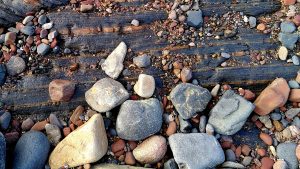 Tuesday 15th April, 10am to 1pm: Wardie Bay – book here
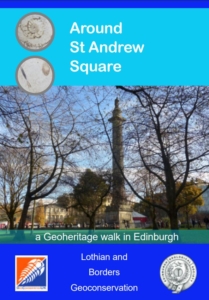 The Lothian and Borders GeoConservation volunteer group are delighted to launch a new leaflet on the buildings in the the eastern part of Edinburgh’s First New Town. Around St Andrew Square has been written by Andrew McMillan, and demonstrates the geology preserved in the largely sandstone masonry of a selection of neoclassical buildings and monuments around St Andrew Square. These buildings were constructed in the late 18th and early 19th century. Imported rock types (largely igneous and metamorphic) employed in more recent architecture also feature. Richly illustrated by many photos by Andrew and Mike Browne, and laid out in an attractive format by Barry Tymon, this is a fantastic new addition to the suite of leaflets produced by the group.
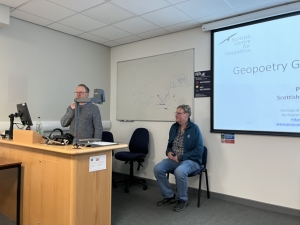
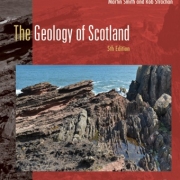
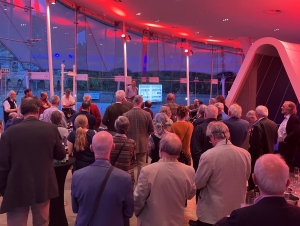 The Edinburgh Geological Society hosted the launch of the new book at Dynamic Earth on 4th September 2024. Almost 30 chapter authors joined the editors and representatives of the Geological Society of London and other organisations for the launch event, which was enjoyed by all and served as a suitable celebration for the hard work over many years to produce the new volume.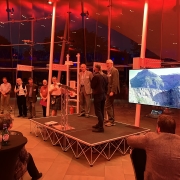
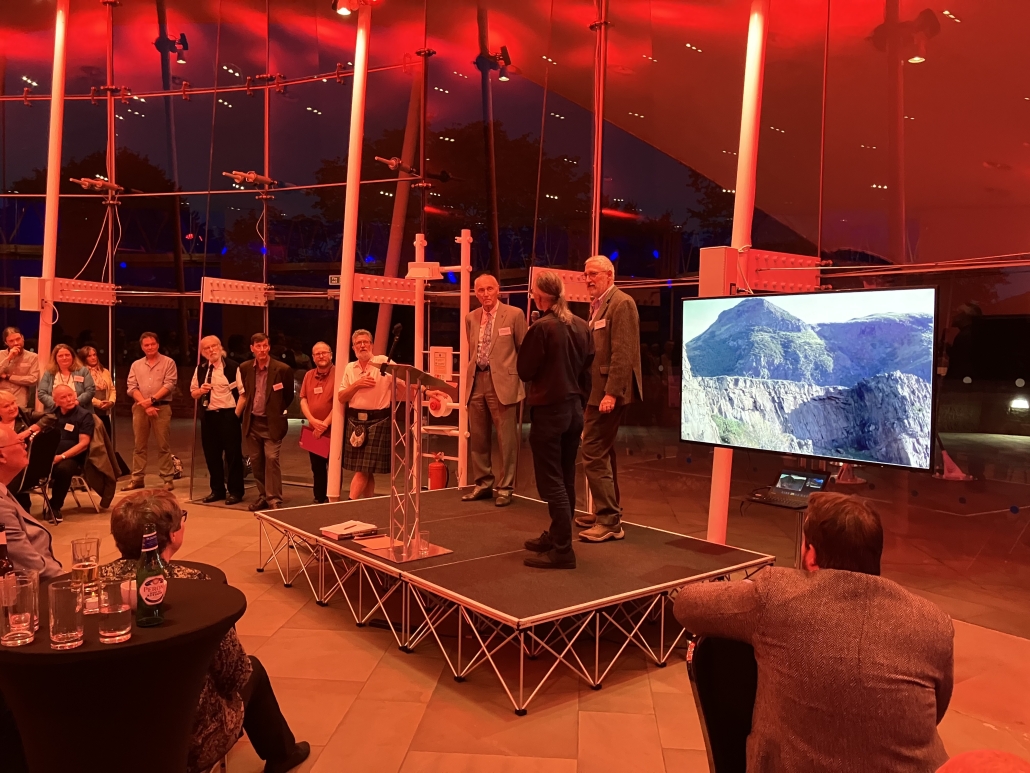 Edinburgh Geological Society takes great pleasure in bestowing an Honorary Fellowship to Dr Colin Braithwaite, for services to the Scottish Journal of Geology. Colin served as editor of the journal from the 1980s, and as Editor in Chief from 2014 to 2023. The fellowship was awarded to Colin at the launch of the 5th edition of The Geology of Scotland at Dynamic Earth in Edinburgh, along with a quaich from the geological societies of Glasgow and Edinburgh.
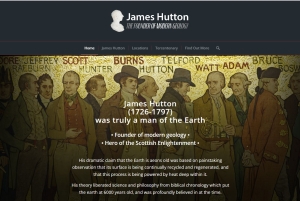 The Edinburgh Geological Society has funded and organised a significant update and revamp of the james-hutton.org website. This website was originally developed in 2006 by Denise Walton and the Borders Foundation for Rural Sustainability, as part of a James Hutton Trail in the Scottish Borders. The partners involved in plans for the Hutton tercentenary in 2026, including EGS and the James Hutton Institute, agreed that a new website would be a useful focus for the tercentenary. EGS worked with web designer Gordon Lang to create the new website, which went live in July 2024 and will be maintained and further developed by EGS in the future. Comments welcome, and if you visit the site you can sign up to a Newsletter to be kept informed of tercentenary plans.