The latest news and information from EGS, including updates on our excursion and lecture programmes, and any other news we think you might find interesting or useful. Please let us know of anything important that we could share with others, by email or using our Contact Form.
The Edinburgh Geological Society is delighted to support the successful campaign, launched by the University of Edinburgh, to save Charles Lyell’s notebooks. The 294 notebooks record in remarkable detail the life, travels, thoughts and ideas of this significant historical geologist. The Society pledged a donation towards the purchase of the notebooks, which were due to be sold abroad. A temporary export bar gave the University and supporters the opportunity to raise the necessary funds to purchase them. Over 1,100 supporters pledged to save the historic notebooks. The purchase price was originally set at £1,444,000, but reduced to £966,000 thanks to a restructuring of tax liability. With the full funds now pledged, the notebooks will be purchased by the University, who have promised to make them as accessible as possible as quickly as possible. You can follow progress on the University of Edinburgh’s Library Blog – libraryblogs.is.ed.ac.uk/lyell/
https://edinburghgeolsoc.org/wp-content/uploads/2019/09/lyells-notebooks.jpg7501000Angus Millerhttps://edinburghgeolsoc.org/wp-content/uploads/2017/01/Edinburgh_Geological_Society_Logo_White_Slogan-1.pngAngus Miller2019-10-17 21:47:092019-10-17 21:47:09Saving & sharing the Charles Lyell Notebooks
The Edinburgh Geological Society fully supports the creation of the Scottish Geology Trust, a new, national charity that will promote and celebrate Scotland’s geology and its value to society, and encourage its conservation. This initiative arose from a meeting of interested parties hosted by EGS last autumn, which included all of Scotland’s geological societies, the Geoparks, universities and museums, geoconservation groups and the Scottish Geodiversity Forum.
The new organisation will offer opportunities for EGS to collaborate with other organisations on projects of national importance, to build on and expand the work of the Scottish Geodiversity Forum and support Scotland’s Geoparks. The Scottish Geology Trust will be a Scottish Charitable Incorporated Organisation and a membership organisation, seeking subscriptions and donations from individuals and organisations. There is strong potential to raise money, for example from the National Lottery Heritage Fund, for significant projects that promote Scotland’s geology and specific sites of national/international importance. Updates will be available on www.scottishgeology.com and the new organisation will be launched in spring 2020.
Edinburgh University has launched a campaign to to save Charles Lyell’s notebooks, which record in remarkable detail the life, travels, thoughts and ideas of this significant historical geologist. The Society has pledged a donation towards the purchase of the 294 notebooks, which are currently in private hands and were due to be sold abroad. Thanks to the level of support already offered, the bar on the export of the notebooks has been extended until 15 October 2019. This is now the final deadline to save Lyell’s notebooks. The price has been set at £966,000 and the University of Edinburgh is making good progress in raising the funds required. If you would like to donate, or find out more about the notebooks and plans to make them fully and freely accessible for the first time, visit www.ed.ac.uk/giving/save-lyell-notebooks, or come along to David McClay’s lecture on 16 October.
https://edinburghgeolsoc.org/wp-content/uploads/2019/09/lyells-notebooks.jpg7501000Angus Millerhttps://edinburghgeolsoc.org/wp-content/uploads/2017/01/Edinburgh_Geological_Society_Logo_White_Slogan-1.pngAngus Miller2019-09-11 12:10:112019-09-11 12:15:00Saving Charles Lyell’s notebooks for research
This informal, outdoor workshop will explore techniques for taking geological photographs. It will be led by Jason Gilchrist from Edinburgh Napier University. No previous experience (in photography or geology) is required, just turn up with any camera. We will take a short walk experimenting with taking photographs at different scales – landscapes, outcrop and close-up details. Participants will be encouraged to submit their photos for future newsletters and the EGS website. If there is enough interest we will arrange a follow-on indoor workshop in the autumn.
Sunday 8 September 2019, 10am – 1pm Meet outside Dynamic Earth, bring a camera, good footwear and warm waterproof clothing
Booking essential – contact Alison Tymon (how to book).
The Scottish Mineral & Lapidary Club has revived and fostered the craft of the lapidary – the engraving, cutting, or polishing of stones and gems; with the objective to encourage an interest in natural minerals and in the crafts and craftsmanship that relates to them.
From Friday 19 – Monday 22 July 2019, the club will put up a display of lapidary work and minerals / materials related to Space, Earth’s Crust, and the Destination Moon at the event in celebration of the 50th Anniversary of the Moon Landing at Dynamic Earth.
The Scottish Mineral & Lapidary Club is situated in Leith, and a lot more of information about its work can be found on the club’s website.
https://edinburghgeolsoc.org/wp-content/uploads/2019/05/destination-moon.jpg613817adminhttps://edinburghgeolsoc.org/wp-content/uploads/2017/01/Edinburgh_Geological_Society_Logo_White_Slogan-1.pngadmin2019-07-15 12:01:122019-07-15 15:17:04The Scottish Mineral & Lapidary Club at Dynamic Earth’s Destination Moon Event
A plaque has been unveiled to commemorate the life and works of the eminent geologist Charles Lapworth LL.D., F.R.S. (1842-1920) at the old Episcopal School in Galashiels. The listed building now housing Border Council’s offices was originally the school where Lapworth was headmaster between 1864-75. He moved to the Borders to teach from his original home in Berkshire. He married Janet Sanderson in 1869 and had four children, three of whom were born in the school house.
The unveiling on 20th May 2019 was done by children of the local St Peter’s Primary school in Galashiels. The efforts to erect the plaque were made by retired local residents and geology enthusiasts, Malcolm Lindsay and David Adamson.
Lapworth is a name which is long associated with Southern Uplands of Scotland. He did his initial research while living locally, but it was not until he moved to Madras College, in St Andrews in 1875 to continue his teaching career that he began to publish his defining work on the distribution of extinct organisms called graptolites. In 1879, he suggested the name “Ordovician” to describe the period between the Cambrian and Silurian ages, a name which was duly accepted across the world. Sir Edward Bailey, the Director of the British Geological Society and Professor of Geology at Glasgow University, later described Lapworth’s interpretation as “one of the miracles of science” and later said that “Lapworth grew up to be, perhaps, the greatest geologist who ever lived”. This plaque is therefore a fitting commemoration to the important time spent by Lapworth both teaching and researching in the Borders.
https://edinburghgeolsoc.org/wp-content/uploads/2019/05/4-Plaque-160519.jpg8641152Neil Mackenziehttps://edinburghgeolsoc.org/wp-content/uploads/2017/01/Edinburgh_Geological_Society_Logo_White_Slogan-1.pngNeil Mackenzie2019-07-15 11:24:252019-07-15 15:14:23Charles Lapworth plaque unveiled in the Borders
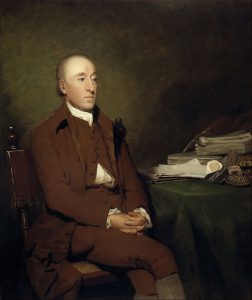
James Hutton by Sir Henry Raeburn, on display in the Scottish National Portrait Gallery
The History of Geology Group (HOGG) of the Geological Society of London and the Edinburgh Geological Society are organising an open meeting, Aspects of the History of Geology in Scotland and the North of England, at Surgeons’ Hall, Nicolson Street, Edinburgh. This meeting will include a programme of talks, several of them given by EGS members, on Thursday 11 July, followed by optional field visits on Friday 12 July.
Friday’s field visits will feature a morning stroll in the Old Town, and an afternoon stroll in the New Town, each two hours long and visiting sites of interest to historians of geology, with the spotlight on James Hutton.
Visit the HOGG website at https://historyofgeologygroup.co.uk/scotland for further details. Booking in advance is essential, payment can be made by PayPal. The conference fee of £40 includes lunch, morning and afternoon refreshments, and an abstracts booklet. The meeting is open to all, you don’t need to be a member of HOGG or EGS to attend.
https://edinburghgeolsoc.org/wp-content/uploads/2017/01/Huttons-locality-Arthurs-Seat_1000px.jpg7501000adminhttps://edinburghgeolsoc.org/wp-content/uploads/2017/01/Edinburgh_Geological_Society_Logo_White_Slogan-1.pngadmin2019-06-20 12:30:292019-06-20 12:29:15HOGG comes to Edinburgh on 11 and 12 July 2019
The EGS has been contacted by the Lochaber Geopark about a crowd-funding initiative – as a not-for-profit charitable organisation, run mostly by volunteers, Lochaber Geopark needs your support to help continue our work and be self-sustaining. Many of us will have enjoyed the wonderful geology of this area and may like to support the worth efforts of the Lochaber Geopark to keep promoting it to a wider audience. If you would like to support them, then please follow the link provided below.
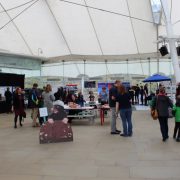
As usual, exhibitors and Dynamic Earth managed to create an event that seemed like being aimed at children, but fascinated the adults just as much, encouraging everyone to touch, feel, laugh – and create their own earthquake catastrophe, should they so wish….
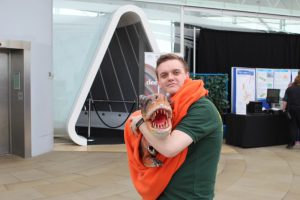
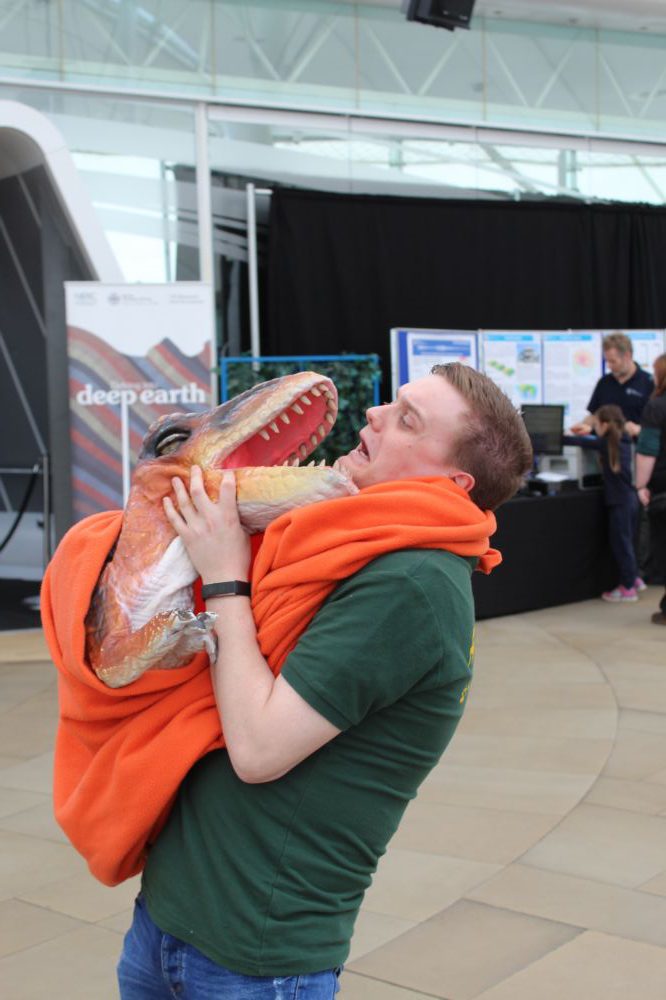
A big winner – the pet dinosaur
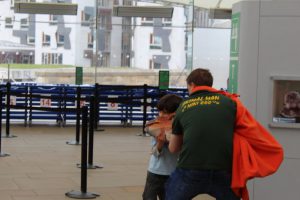
Visitors, especially of the childlike persuasion, enjoyed the warm welcome by a friendly pet dinosaur, carefully carried by a volunteer animal keeper.
Hands-on-Attitudes
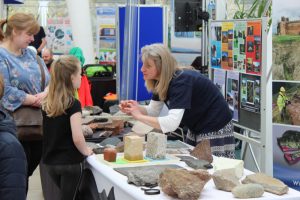
The BGS rock exhibition – looksies AND feelsies
It is one thing to hear and read about rocks, but touching them, seeing, feeling – and, if possible, smelling the difference is so much better!
The BGS rock samples found many fans.
landscape formations and their effects
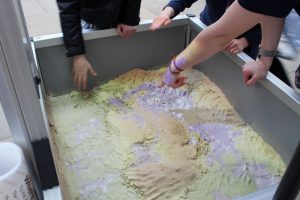
Another extensively used item was the simulation of landscapes and their influence on water flow and water levels. Children (and adventurous adults) could shape a landscape in the sand; depending on the height of ‘hills’ and ‘valleys’ light simulated the water flow after a rainfall, or its changes after a landslide.
The QuiverVision app: print – colour – play
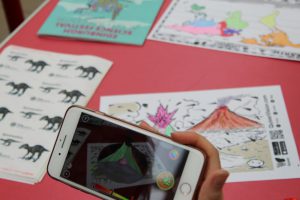
An interesting use of modern technology was demonstrated by the QuiverVision app: visitors could choose a template, colour it in, and the app ‘animated’ it – watching one’s self-created volcano erupt is oddly satisfying, not just for children (we can assure from personal experience…).
The website offers a wide variety of templates for downloading.
Who wouldn’t want to cuddle with the pet dinosaur
Of course, some had their own ideas of what they wanted to get their hands on. And truth be told, who wouldn’t want to cuddle the pet dinosaur?
Downloadable templates for dinosaur hand puppets can be found on the BGS website.
Earthquake!
Earthquake simulation on one of Scotland’s most important buildings
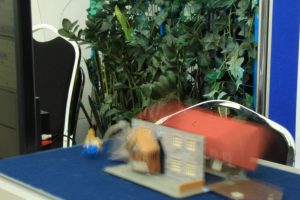
To the surprise of absolutely no one, the earthquake-simulation-table was equipped not only with imposing, but also with some of the most important buildings of Scotland.
EARTHQUAKE!
Additional to the fun of watching your self-created earthquake, experts from the BGS explained not only the works of a seismometer, but also presented real-life-earthquake data and gave an overview of earthquakes in Britain (more than one would anticipate, but mercifully weak).
Very good information material about earthquakes, but also on volcanoes and plate tectonics, can be found on the BGS website.
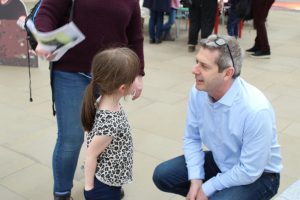
Professor Stewart discussing with what we hope will be one of our future geologists.
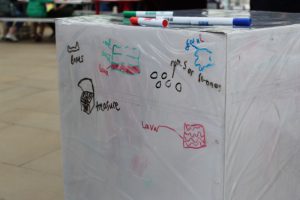
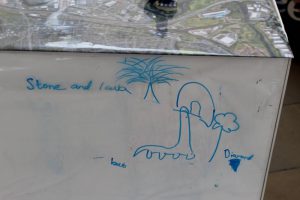
Dealing with questions and (mis-)conceptions about the effects of boreholes and geothermal projects underground, he asked the visitors what ideas they had about ‘earthquakes’, and invited them also to draw what in their opinion was to be found in the earth beneath Glasgow….
Treasures, bones, and lava…
…stones, diamonds, and dinosaurs
Once more it was demonstrated that science doesn’t have to be ‘watered down’ to be fascinating for people of all ages, just presented in appropriate (and entertaining) ways, by people whose love for science is rivalled only by their creativity.
A thoroughly fascinating and enjoyable experience.
Although….
Accidents *did* happen
…at the end of the day, some had a bit of bad luck…
Our thanks go to all exhibitors, volunteers, and enthusiastic young scientists.
https://edinburghgeolsoc.org/wp-content/uploads/2019/05/Overview_IMG_6533.jpg6661000adminhttps://edinburghgeolsoc.org/wp-content/uploads/2017/01/Edinburgh_Geological_Society_Logo_White_Slogan-1.pngadmin2019-05-07 21:34:402019-05-08 12:05:38Science Festival 2019: Delving into Deep Earth, Exploring our Final Frontier
Contains public sector information licensed under the Open Government Licence v3.0.
On the 6th of February, a joint lecture of the Mining Institute of Scotland (MIS) and the Edinburgh Geological Society (EGS) was held at the Grant Institute of Geology , University of Edinburgh.
Dr Hugh Barron of the British Geological Survey (BGS, Scotland) gave us an overview of the Glasgow Geothermal Energy Research Field Site GGERFS, a research facility run by BGS Scotland and the Natural Environment Research Council (NERC), who also carry part of the funding.
Why geothermal energy?
Currently, only about 20% of Scotland’s total energy consumption is covered by renewable energies. It doesn’t sound impressive – and certainly we hope to do better in the future – still, compared with the rest of the UK, Scotland is remarkably successful in its implementation of renewable energies. And while our heat energy consumption is on average 3% higher than in the other parts of Britain (information accompanied by sympathetic laughter from the audience), compared with 2006 it has been reduced by impressive 30%.
New technologies may extend our exploitation of fossil fuels but they remain a finite resource. And considering the current rate of Global Warming it is even more important to find ways of generating energy which are low in CO2 and / or CH4 emissions. Geothermal energy clearly offers an interesting alternative.
Geothermal energy – for most people this conjures images of Iceland, where active volcanism provides subterranean heat, and hot springs are used in ingenious and spectacular ways. How could Scotland compare? For while our geology speaks of a rich volcanic past, by now our volcanoes are all extinct; eroded remnants of former explosive power.
However, geothermal energy is not just a question of how hot, but also of how much – relatively small differences in temperature over a large body of water still contain huge amounts of energy.
The tricky part is to extract this energy – and to make it widely available. As of now, it’s neither commercially nor technologically feasible to install a geothermal system for a single household property. For the most part, facilities are installed in large edifices or building complexes.
Projects of this kind do exist: the town of Heerlen (Netherlands) has been running a minewater scheme since 2008. In Scotland, facilities were installed in Shettleston (Glasgow), and in Lumphinans (Fife). These two projects had to be stopped in the meantime, due to problems with clogging (Shettleston) and a lack of qualified personnel for maintenance (Lumphinans).
This shows why it is so important to run a research program to find solutions for those technical problems, and to create the base for reliable and easy to run systems.
An image from the public exhibition in Dalmarnock, Glasgow (September 2015), which presented the plans for the geothermal energy research field site. Staff from the BGS explained the research and answered the visitors’ questions:
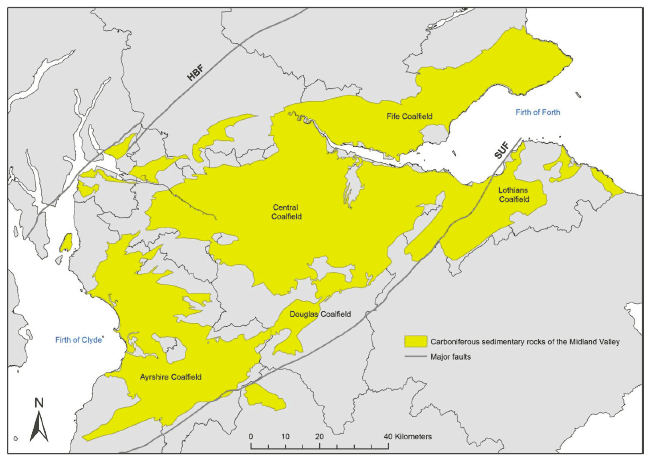
Between the Highland Boundary Fault in the North and the Southern Uplands Fault in the South, we find five large coal mining areas:
The Fife Coalfield
The Central Coalfield
The Lothians Coalfield (which crosses the Southern Uplands Fault in an eastwards direction)
The Douglas Coalfield
The Ayrshire Coalfield
https://www.gov.scot/crown-copyright/
Thousands of miners worked for centuries to extract the coal. What better way to honour their hard and dangerous work, than by re-using their constructions to improve our lives, protect our environment, and increase our knowledge?
Recycling
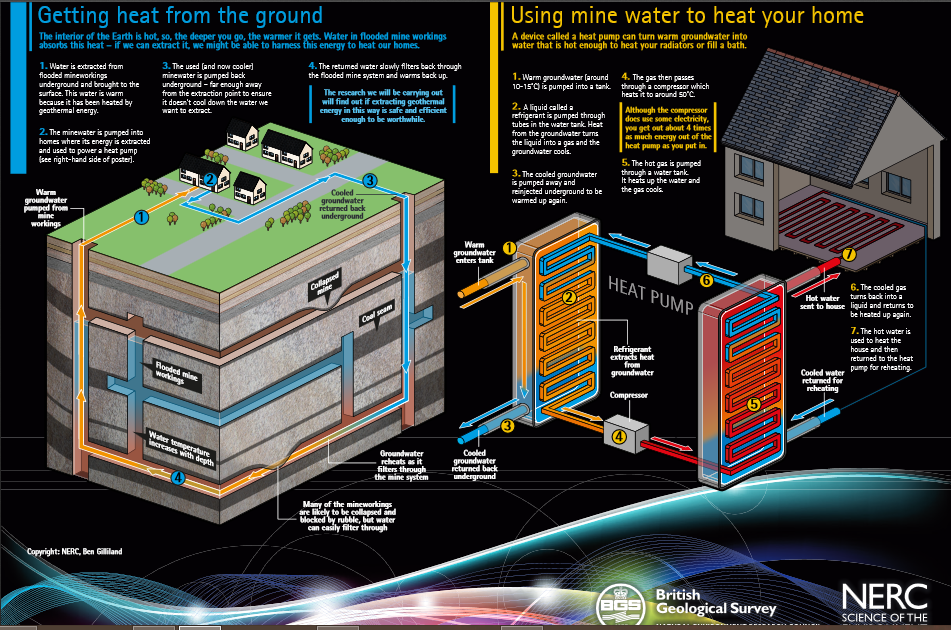
To use old coal mines offers a couple of advantages. The mines reach down to a depth of ~ 900 m, the shafts allow easy access to warm water with a maximum temperature of ca. 37° C. Records of these mines are still held by the BGS, and can offer information about promising future sites.
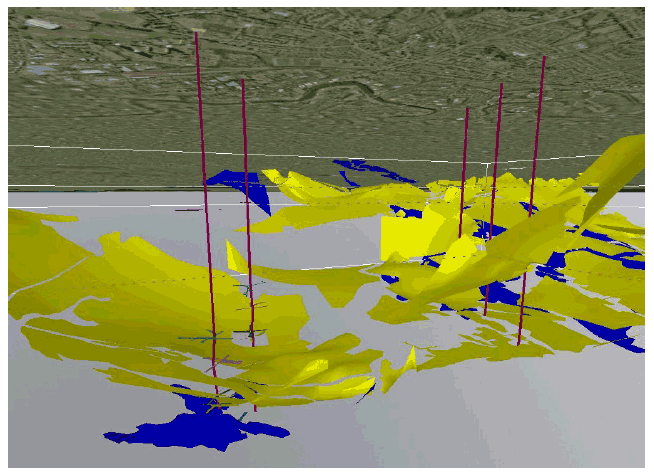
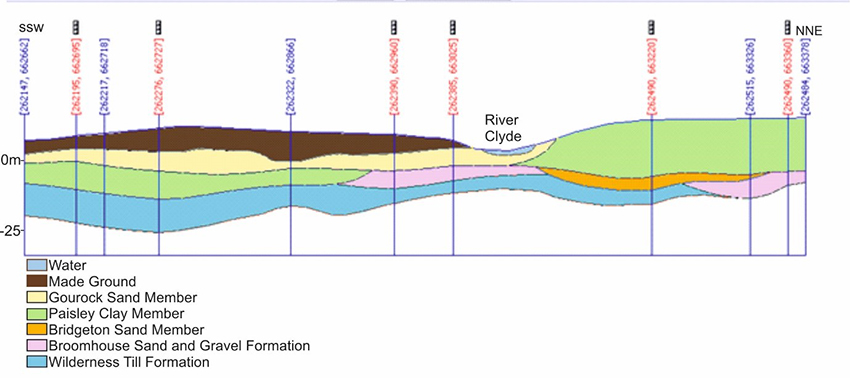
An interesting 3D view of the faulted and folded coal seams under the East End of Glasgow is provided by the Scottish Government:
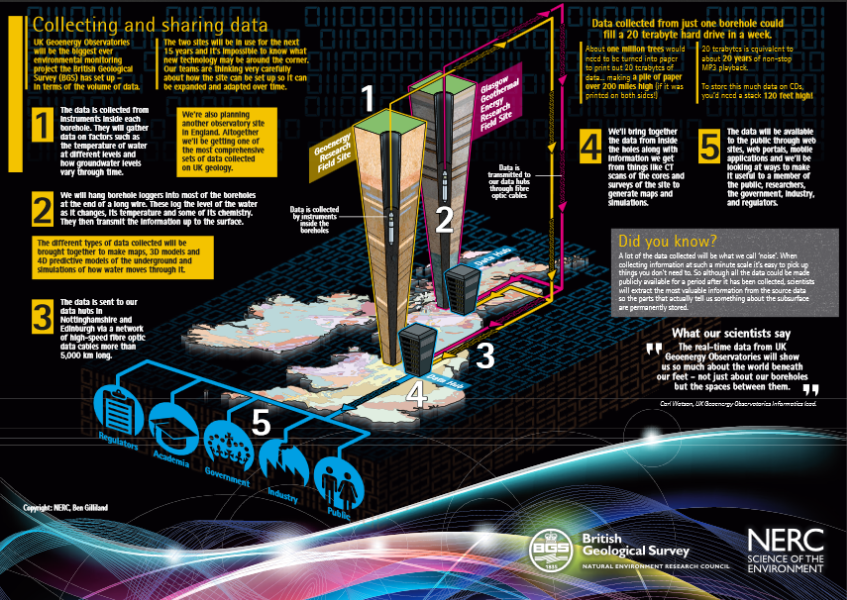
The research is realised via the UK Geoenergy Observatories Project.
The project was commissioned by NERC, while BGS will carry out the research infrastructure and operate the facilities.
Two research sites have been created, with the aim to
Independently monitor underground energy technologies
Gather scientific evidence on new and established energy and storage technology to increase efficiency and sustainability
Gain a world-class understanding that could support management and regulation
Develop new, exportable technologies
The project’s timeline is set for 15 years, the duration of its last stage as a research facility will depend on the interest shown by the academic community.
There are many benefits to be gained from a dedicated research site.
First, as fracking has shown, we need to learn in advance what impact energy extraction might have on geology and environment. All the more, since effects cannot be directly observed, and intervention deep in the bedrock would be difficult or even impossible.
The people living close to these sites have a right to know what effects any project could have on their lives. As long as this information cannot be provided, the new technology isn’t likely to be accepted.
Secondly, this is an opportunity for gathering academics working in different fields. As astronomical missions are shared by many research teams, this could become a site where scientists can co-work in a professional environment, and share information across the borders of research interest or nationality.
Finally, besides technology, these days it’s mainly expertise that becomes a commodity. And more than money can be gained: to share knowledge is also an important way to connect people all over the world. Also, it’s in our own interest to help other countries to reduce their CO2 emissions, as the effects of Global Warming caused in one country won’t stop at the borders of the next.
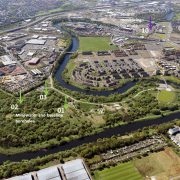
The site itself is situated in the Cuningar Woodland Park, a community park which successfully managed to encourage usage by the local community. Its quite charming welcome sign at the entrance, a quote from Dr Seuss
“Welcome…’If you never did you should. These things are fun and fun is good.'”
could apply to geology, as well as to all other sciences.
Soil and bedrock at the site are a mixture of both natural and man-made formations.
Not all planned boreholes could be installed. The ‘surviving’ two include a weather station, gas probes, sensors for CO2 and CH4, and an active satellite based inSAR ground motion sensor. Seismometers are included as well ( in fact, they had been installed just the day before the talk). They are part of the UK seismic monitoring network.
The data acquisition in total includes environmental monitoring, soil chemistry, hydro-geochemistry, noise, and ecology.
The Future
The project is not meant to produce enough heat to cover all its costs, rather it is planned to finance itself through its use as a research site.
This research might include measuring the impact of the geothermal technology on the local environment, new technology, and even defining a base for legal and regulatory framework (as of now, there is no regulatory regime for geothermal technology in Scotland or the UK). In order to turn geothermal energy and heat into a profitable as well as beneficial industry, the extent of all related costs has to be established.
Research topics envisaged so far:
Faulting and subsurface flow partitioning
Chemical and heat tracer tests
Flow rates and sustainability of heat yields
Thermal breakthrough
Subsurface to surface impacts
Strategies to minimise clogging
Geo-microbiology
New technologies
An online data portal to make the results available for scientists and engineers world wide is planned.
The lecture offered an interesting view on a so far little-explored way of creating energy in Scotland. This project combines modern technology with the past – the constructions as well as the documentation held by the BGS – to add another piece to the mosaic of modern, decentralised energy production. The knowledge gained here can help to facilitate the use of geothermal energy even on a modest scale. The smaller and simpler the technology, the wider the possible application world wide.
Thanks & Acknowledgement
Gratitude is owed to Dr Barron for holding this lecture. He gave a clear overview of the project, its background, goals, challenges and future. He also kindly answered many follow-up questions at the traditional after-talk-tea at the Cockburn Geological Museum.
Links
Contact Dr. Barron
hfb@bgs.ac.uk
British Geological Survey
https://www.bgs.ac.uk
NERC
http://www.nerc.ac.uk/
Grant Institute of Geology
https://www.ed.ac.uk/geosciences
University of Edinburgh
https://www.ed.ac.uk/
Glasgow Geothermal Energy Research Field Site GGERFS
https://www.bgs.ac.uk/research/energy/esios/glasgow/
Potential for deep geothermal energy in Scotland: study volume 2
https://www.gov.scot/publications/study-potential-deep-geothermal-energy-scotland-volume-2/pages/9/
Open Government Licence for public sector information
http://www.nationalarchives.gov.uk/doc/open-government-licence/version/3/
https://edinburghgeolsoc.org/wp-content/uploads/2019/05/cuningarLoopClydeGatewayCopyright-480x480.jpg532800adminhttps://edinburghgeolsoc.org/wp-content/uploads/2017/01/Edinburgh_Geological_Society_Logo_White_Slogan-1.pngadmin2019-05-07 18:41:072019-05-07 18:41:07Recycling the Past to Research for the Future: the Glasgow Geothermal Energy Research Field Site (GGERFS)
We may request cookies to be set on your device. We use cookies to let us know when you visit our website and how you interact with it. This enables us to keep improving it.
Click on the different category headings to find out more. You can also change some of your preferences there. Note that blocking some types of cookies may affect your browsing experience and the services we are able to offer.
Essential Website Cookies
These cookies are needed for us to provide our website services and features as intended.
Rejecting them is likely to affect how our site functions for you. Cookies can always be blocked or deleted by changing your browser settings. However, this will always prompt you to accept/reject cookies whenever you revisit our site.
We respect your wish to refuse cookies, but to avoid asking you repeatedly kindly allow us to place a cookie to store that preference. You are free to opt-out any time or opt-in for other cookies to get a better experience. When you refuse cookies we will remove all set cookies in our domain.
We provide you with a list of stored cookies on your computer in our domain for you to check. Note, for security reasons, we are unable to show or modify cookies from other domains. You can check those in your browser security settings.
Google Analytics Cookies
These cookies collect information that is used either in aggregate form to help us understand how our website is being used or how effective our marketing campaigns are, or to help us customize our website and application for you in order to enhance your experience.
If you do not want that we track your visit to our site you can disable tracking in your browser here:
Other external services
We also use different external services like Google Webfonts, Google Maps, and external Video providers. Since these providers may collect personal data like your IP address we allow you to block them here. Please be aware that this might heavily reduce the functionality and appearance of our site. Changes will take effect once you reload the page.
Google Webfont Settings:
Google Map Settings:
Google reCaptcha Settings:
Vimeo and Youtube video embeds:
Privacy Policy
You can read about our cookies and privacy settings in detail on our Privacy Policy Page.


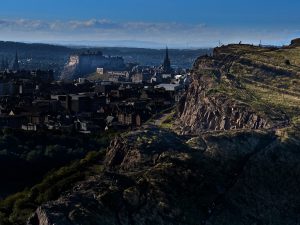 This informal, outdoor workshop will explore techniques for taking geological photographs. It will be led by Jason Gilchrist from Edinburgh Napier University. No previous experience (in photography or geology) is required, just turn up with any camera. We will take a short walk experimenting with taking photographs at different scales – landscapes, outcrop and close-up details. Participants will be encouraged to submit their photos for future newsletters and the EGS website. If there is enough interest we will arrange a follow-on indoor workshop in the autumn.
 The Scottish Mineral & Lapidary Club has revived and fostered the craft of the lapidary – the engraving, cutting, or polishing of stones and gems; with the objective to encourage an interest in natural minerals and in the crafts and craftsmanship that relates to them.